

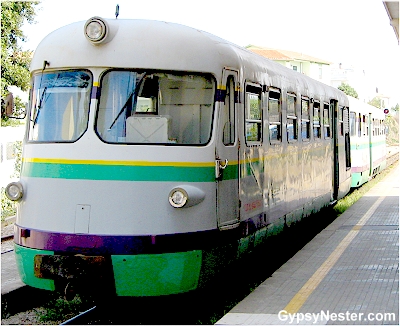
It’s a pleasant thirty minutes ride from Sassari, where we were staying, to the seaside gem of Alghero on the famous “Little Green Train” (Trenino Verde).
This popular narrow gauge railroad serves Sardinia and dates back to 1888.
In 1921, author D.H. Lawrence said of Trenino Verde, “It’s a strange railway. It shoots up hills and down into valleys and races around sudden curves with the greatest nonchalance…”
Though we would have to leave the leg of the railroad that D.H. spoke of for a future trip, we were able to get our train fix with the shorter jaunt to Alghero.
Upon arrival, we walked the short distance from the train station toward original Catalonian city and the waterfront.
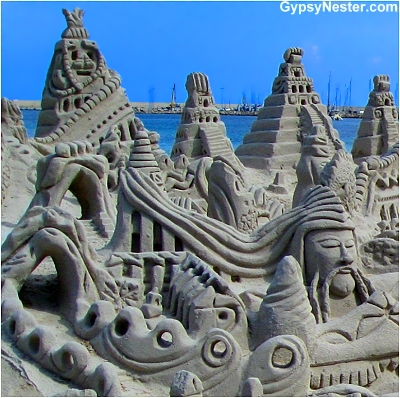
Rounding the corner to the beach, we encountered an astonishing sand sculpture by Antonio Iannini.
He has crafted an artistic history of the region’s culture, religion and politics using only the fine grained beach
sand and water.
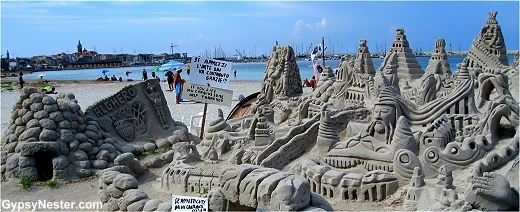
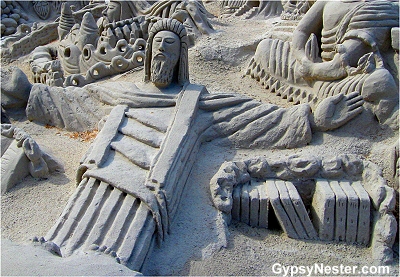
Amazing! The artist lives and breathes his art, constantly tweaking his masterpiece, while living in a van and a tent on the beach at Lido S. Giovanni.
Articles lauding his incredible work from all over the world were included as part of Iannini’s display.
The beach leads past the marina filled with both pleasure craft and local fishermen’s boats to the walls of the old city. While gawking at the boats and the majestic view of Capo Caccia, we managed to miss the main gateway through the ancient wall into city.
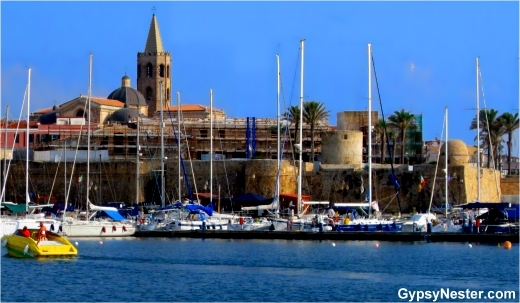
Capo Caccia is the point at the end of the peninsula that forms the bay, Porto Conto, about seven miles across the water from Alghero.
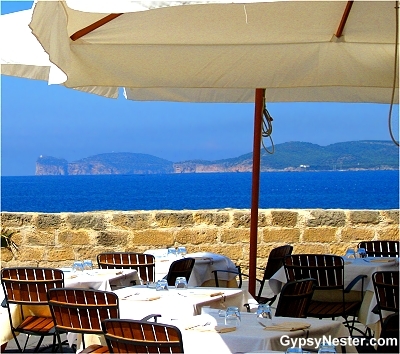
It looks a bit like the rock of Gibraltar, rising nearly a thousand feet straight up out of the Mediterranean Sea.
Moseying on, we discovered stairs up to the top of the Bastion that guarded the city from invaders for centuries. After a quick check to make sure none of the local citizens were boiling oil to ward off our invasion, we scaled the wall.
It is always a striking experience to venture inside the walls of an historic Italian city but even more so in Alghero. The mix of cultures over the centuries has left a truly unique place. We could hardly wait to explore–but first, sustenance.
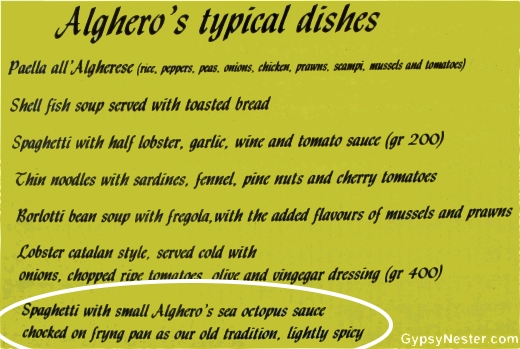
Fortunately, there were many choices for our growling stomachs along the top of the ramparts. After surveying the options, we decided on Mirador both for its incredible location — jutting out from the wall atop a turret — and several menu items that caught our eye.
How could we pass up “Spaghetti with small Alghero’s sea octopus sauce chocked on frying pan as our old tradition?”
We couldn’t. Humorous as menu translations may sometimes be, the food was absolutely wonderful.
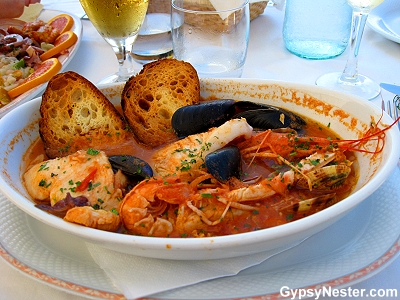
Shellfish soup served with toasted bread and the “festival of the sea” platter of various Mediterranean delicacies started off the meal.
Most of the sea creatures were ones that were familiar to us with a large exception being a shrimp-like guy with lobster claws that had a sweet taste we likened to Alaskan king crab.
We felt we could live on the soup for the rest of our lives, but then the waiter brought out the octopus spaghetti! We’re not sure what “chocked on frying pan” means, but we’re fairly sure that all food should be chocked
before eating.
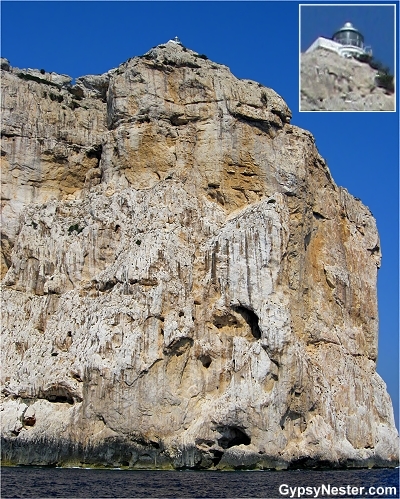
After gazing out toward the majestic Capo Caccia throughout the meal, we decided we must see it up close.
You can get there by land and then walk down 656 stairs to the sea and the immense cavern of Neptune’s Grotto.
But we were dying to get out onto the water and what better way to see the cliffs up close than from a boat?
Besides, the 656 steps back UP was a rather daunting proposition.
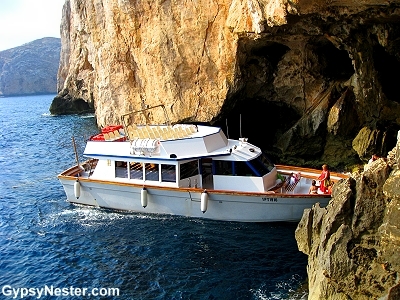
We headed back to the marina to secure a spot on the next boat.
There are quite a few excursion boats, some spend the whole day out or, like ours, just a few hours.
We sped across the bay about half an hour until we were mouth-open staring straight up the rock face from the bottom of the sheer cliff.
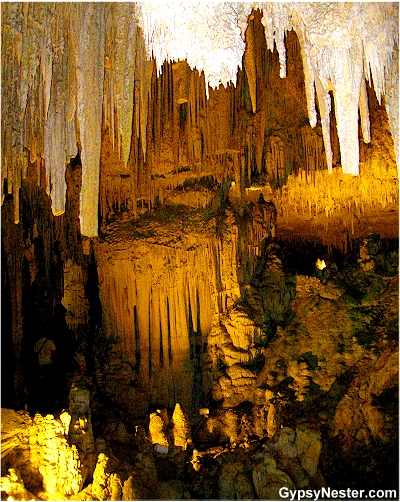
There’s really not a word to describe it but it’s a lot like looking off the top of a huge skyscraper, only up.
From there, the boat cruises around several giant rock formations with caves and arches carved into them by the sea on the way to Neptune’s Grotto.
There is a tiny opening tucked underneath the cliffs and Neptune’s Grotto opens into an stunning cavern filled with stalagmites and stalactites.
After our boat ride, we headed back to the town to absorb some of its culture and history. Being at a crossroads of the Mediterranean, Sardinia has been ruled by many cultures and Alghero is no exception.
Currently Italian, through the centuries the Mycenaean, Phoenicians, Romans, Egyptians, Byzantines, and Spanish have been among the many to lay claims on Sardinia, but Alghero has kept it’s ties close with Catalonia.
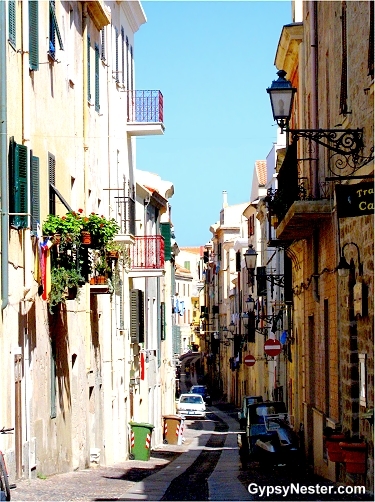
The Catalan flag flies along side the Italian and Sardinian and the dialect is still widely spoken. The influence can be seen in the architecture, the food and everywhere your eye falls.
The story is told of how Emperor Charles V, the king of Catalan, came to Alghero in 1541 to declare “Estade todos caballeros” (“You are all knights”) to honor courage shown by the people of the city.
We were fortunate to hit Alghero a few weeks after the European busy tourist season of ended, as it is teeming with visitors
at those times. The streets were uncrowded and the temperature was perfect for beach going, water sporting and sightseeing.
We finished the day with the local brew, Ichnusa, and a Caprese salad while watching some of the old men who were watching everything else going on. If you spend some time in Italy, you’ll find that watching really is the great Italian pastime. We’re learning to find the merits in it.
Salute!
David & Veronica,
GypsyNester.com
Looks like you had a fabulous time. Just outside of the high season is the perfect time to visit and the “Spaghetti with small Alghero’s sea octopus sauce chocked on frying pan as our old tradition” sounds superb! 😉
We did Kathryn! Still not sure what “chocked on frying pan” means though.