

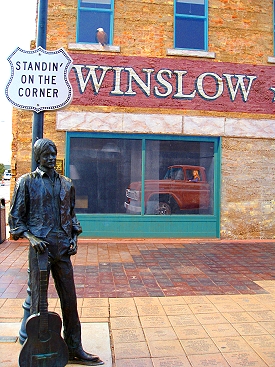
While we are firm believers in a Take it Easy philosophy, we have never been standing on a corner in Winslow, Arizona before.
Call us wacky, we were pretty stoked about it. The town of Winslow is pretty stoked, as well.
They built a little monument to the lyric, complete with a mural of a girl, my lord, in a flatbed Ford slowing down to take a look at the statue named “Standing On The Corner.”
It’s painted as if it is a reflection in a plate glass window and really works. The mood is captured.
Cool as it was to climb inside an Eagles song, we wouldn’t rate it as trip-worthy to northeast Arizona by itself.
It happened to be right on our way to the Petrified Forest. Leaving behind the billboard that says “Winslow, Arizona says ‘Take it easy,'” we made our way through Holbrook.
Once known as “the town too tough for women or churches,” the feature that really caught our eyes was a little road along the railroad tracks named Bucket of Blood Street.
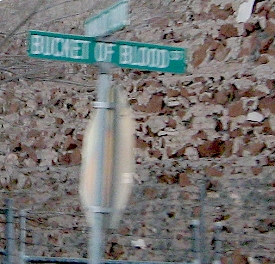
That’s not the kind of name that we could just let go by without some investigation.
Turns out that Terrill’s Cottage Saloon was the scene of one of the most notorious shootings in the old West.
When Grat Dalton of the notorious Dalton Gang shot two players in a card game, everyone said that the floor looked like someone spilled a bucket of blood.
The saloon and the street had a new name.
Unfortunately, after wetting the whistles of parched adventurous western travelers for a century or so, The Bucket has been boarded up.
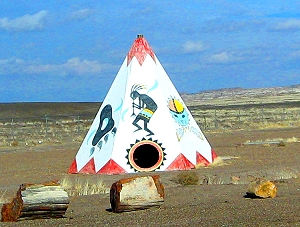
A few miles more and we spotted teepees in the distance.
Out in these parts that could only mean one thing, cheesy crap shop.
Sure enough, guarding the entrance to Petrified Forest National Park stood a classic.
In addition to the cement tents outside, the inside was stuffed with horrible fake headdresses, rubber arrows, polished rocks, Jackalopes, rattlesnake eggs, fools gold and of course, petrified wood.
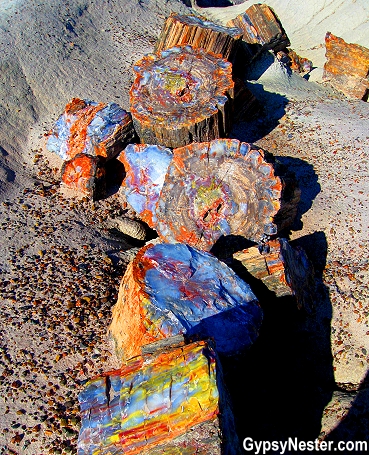
Once inside the park, things took a distinct turn for the more serious.
First, we were warned, multiple times, not to take any samples of the fossilized wood home with us unless we were willing to face a $325.00 fine.
While that may seem harsh, it obviously isn’t a strong enough deterrent, since an estimated twelve tons of petrified wood is stolen from the park every year.
Luckily, the big stuff isn’t going anywhere.
The Petrified Forest is definitely a drive-through park.
A road stretches twenty-seven miles north-to-south through the forest with numerous pullouts and side roads for viewing the sights.
Calling it a forest gave us the wrong impression. The petrified trees are all laying on the ground, left there about 225 million years ago during the Late Triassic period.
When we think forest, we expect large groups of upright trees. We felt kind of dumb.
See more photos and our antics in The Petrified Forest!
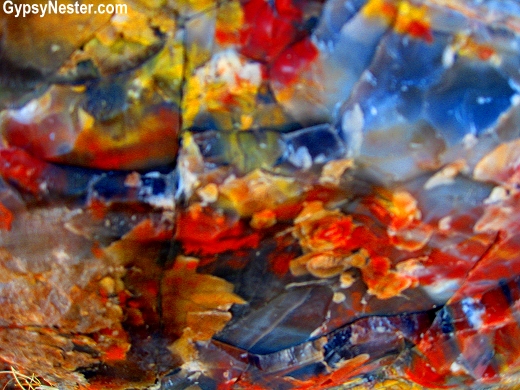
All those million years ago this area was an upright tropical forest.
Fallen trees accumulated in river beds and were buried by volcanic ash.
The silica in the ash dissolved and seeped into the logs, forming beautiful quartz crystals.
Other minerals combined with the silica to create the rainbow of colors in the petrified wood.
Buried for eons, it wasn’t until about sixty million years ago that the Colorado Plateau began to be pushed up, forming mountains and allowing erosion to expose this ancient lumber.
After a quick stop at the visitors center to grab a map and some info, we were ready to explore.
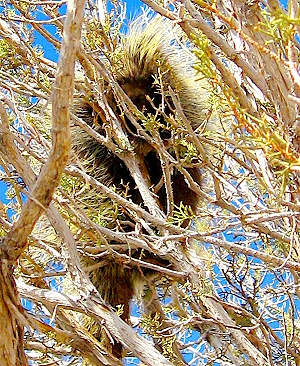
But before we could begin our adventure, the ranger pointed out a couple of porcupines in a tree by the parking lot.
Never having viewed one of the prickly little critters up close, we had to go in for a look.
Two big quill pigs were chowing down on the poor tree and pretty much oblivious to any strangers approaching.
Veronica dubbed them “cute” but I don’t think she’d feel that way if she tried to pet one.
Wildlife encounter completed, we drove up from the south entrance to our first stop, The Crystal Forest.
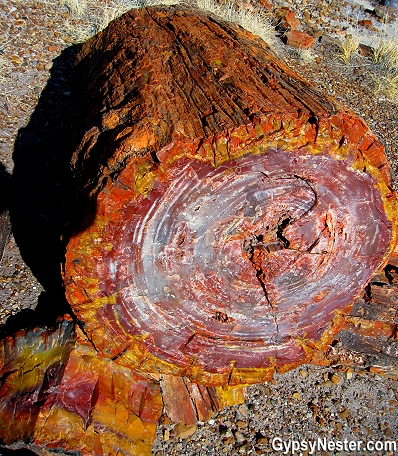
A walking trail leads through the hundreds of downed ancient trees in this forest, giving us our first up close look at the petrified wood. It’s amazing how the rock has retained the exact look of the trees.
The grain, rings and even the bark are perfectly preserved in stone.
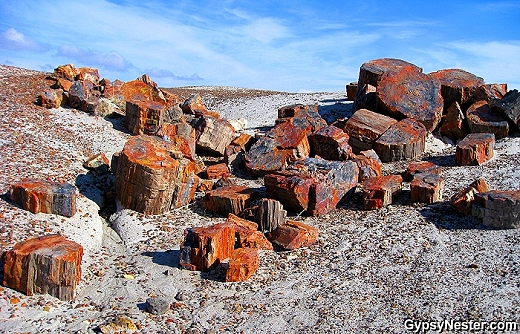
Our next stop was Blue Mesa. From the top of the mesa we got a great view of valleys filled with petrified logs. Many of them have rolled down and gathered in the canyons, while others are still being exposed by erosion that continues today.
From the mesa, we continued on to Newspaper Rock.
A telescope is required to get a good look at the petroglyphs that give the rock its name.
Symbols and images were etched onto the rock by the original inhabitants of the park as far back as 2000 years ago.
Some of the rocks in this area are covered with “desert varnish,” a thin dark coating of minerals and microorganisms that the native peoples used to tell their stories by scratching pictures into the rock surfaces.
The meanings of most of these writings remain a mystery, but it is speculated that they may have been a part of religious ceremonies, story telling and just plain preserving information. Sounds a lot like what newspapers have always done.
See more photos and our antics in The Petrified Forest!
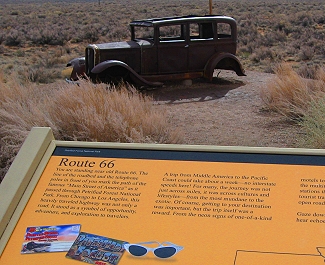
As we continued north, we crossed I-40 and took a quick look at the Route 66 marker.
When the old highway came through here in the twenties, tourists began discovering this unique fossil collection.
Unfortunately, they also began removing a lot of the specimens.
The park was preserved as a national monument by Teddy Roosevelt (who else?) back in 1906, but it wasn’t until the depression that Civilian Conservation Corps workers built infrastructure for the park and began to really protect it, slapping the hands of sticky-fingered tourists.
In 1962, the monument became Petrified Forest National Park.
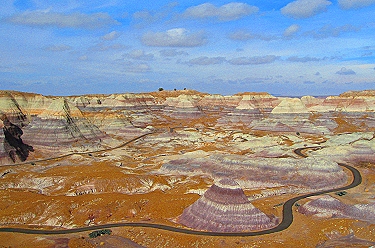
Beyond the new and old highways to the north, The Painted Desert stretches out for breathtaking miles.
This giant stretch of “badlands” is protected as the Petrified Forest National Wilderness Area.
Most of it has no roads and is accessible only by foot. We decided to view it from afar and found incredible panoramic views at several pullouts in this part of the park.
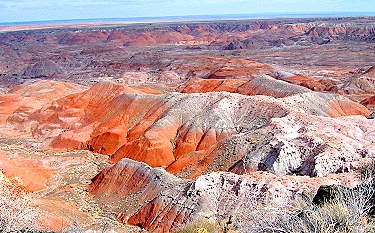
Our timing could not have been better.
The swiftly sinking sun highlighted beautiful Earth tones, reds, browns and orange that are layered in volcanic strata across the mountains.
The same minerals that give the petrified wood so much color, provide the “paint” for the Painted Desert.
Having enjoyed nature’s art exhibit, we were ready to call it another fantastic day. We were pretty sure that we should drive far enough away to spend the night at a safe distance from The Bucket of Blood.
Better to be safe than sorry.
David & Veronica, GypsyNester.com
Oh my!! That petrified wood looks like real jewels. I have heard about this place but never seen such gorgeous photos. The scenery is to die for too. Now, I want to visit so bad.
I’ve never seen petrified wood this colorful. Will you be going to Canyon de Cheilly this trip?
We did not make it to Canyon de Cheilly this time. something to see on our next visit.
Wish we would ditch our house and hit the road, and be free!
Hahaha..life imitating Art! :)))
I've been in Winslow, Arizona. The meteor crater near there is worth a trip to see!
That is pretty cool…Being a huge Jackson Browne fan, I may just have to go and get my picture taken there!!!
Awww, we went to Winslow and Santa Fe too! But I can see we definitely need to get back to see the Petrified Forest! GREAT PHOTOS!! http://bit.ly/hJAby
Looks like a great place to visit to be sure! Thanks for sharing!
Love it! I am so stoked to have found your blog. I am an almost empty-nester and have started practicing so I will be ready. Till then, I can live vicariously through your awesome adventures. Rock on!!
Loved this post! We were in the Petrified Forest back in 2006, but your photos are much nicer than ours. LOVE the close-up. Great idea! Also loved the Winslow, Arizona story and photo – we didn't get there, but of course are very familiar with the song. Love the mural and sculpture! Thanks for sharing your travels!
I actually stood on a corner in Winslow, Arizona, in Sept. 1962, but probably not the same one pictured. Never forgotten, thanks to the Eagles.