
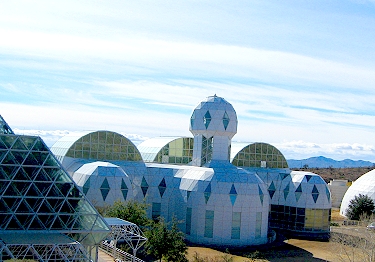
Just outside of Tucson, near the little town of Oracle, Arizona, one of the world’s great scientific experiments took place.
When the Biosphere 2 experiment began, it caused such a stir that it became a part of pop culture, even getting a mention on Seinfeld, and nothing says “made it” like a Seinfeld reference.
These jokes and news blurbs were all we knew about the Biosphere when we decided to check it out. We had no idea what to expect.
For some reason (we blame Mr. Seinfeld), we had a mental picture of a handful of hippies living underground in some sort of glorified bomb shelter. What we did find was somewhat more sophisticated than that.
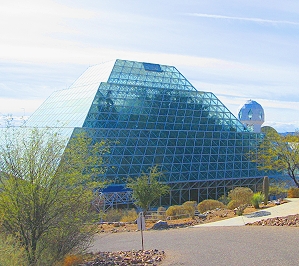
As we drove up, it was plain to see that this was no storm cellar. The buildings scream space age, especially against the high desert landscape. We were greeted and led into a room that served as the eating area for the “biospherians” that lived here. This is where our tour would begin.
Our guide gave us the lowdown. He explained Biosphere 2 is so named because Earth is biosphere numero uno, and then went on to the vital statistics.
Over seven million square feet of glass covers 3.14 acres of five distinct biomes, creating the largest closed system ever created. Everything is kept in ecological balance by some incredibly high-tech mechanisms.
The original concept was to study the feasibility of space colonization, so this was build as the “tightest” building on Earth. It is even sealed underground with a five hundred ton welded steel liner. The final result is a building that’s even more airtight than the space shuttle.
Before we ventured into the sealed off biomes area, our escort filled us in on the human aspects of the Biosphere experiments. Two separate groups participated in the missions.
The first eight “biospherians” were sealed in for two years starting in 1991. There were a few glitches. It took the crew some time to adjust – mostly to the diet – but in time they gained back their lost weight and ultimately raised almost all of their own food.
Social differences arose and the team split into two factions, but managed to continue their duties. Sounds like it would have made an excellent reality TV show.
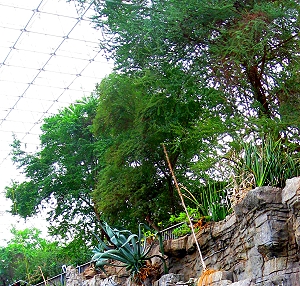
Considering the length of time they were confined, we thought anything short of murder should be celebrated as a resounding victory.
Oxygen had to be added to the system twice, due to unforeseen losses from curing concrete and microbes in the soil – not boding well for living in space – but overall the experiment was reasonably successful.
The same could not be said for the second attempt in 1994. A few days after being sealed in, some of the previous mission’s crew sabotaged the experiment by breaking the seal on the Biosphere.
It went downhill from there. Bickering among the personnel, and management differences, were so bad that the scheduled ten month mission was aborted after just five. Still, for those few months, the crew did manage to grow all of their own food, so there was a glimmer of success.
The next year, Columbia University took over the site as a research facility and campus. A few years later the University of Arizona began using the site as a climate change laboratory and is continuing with ongoing research today.
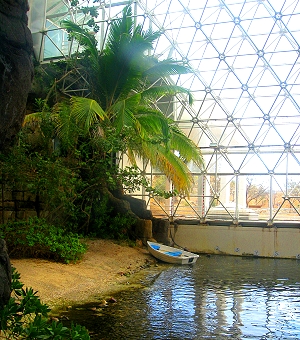
With our heads chocked full of knowledge, we were ready to go in for a look. The tour took us through all five of the distinct biomes inside the sphere, beginning with the mangrove wetlands that led us along the shore of the self contained ocean, complete a with coral reef. At nearly four thousand feet above sea level, this is by far the highest ocean in the world.
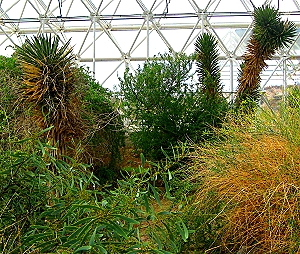
From the seashore, we made our way through the savannah grasslands and the fog desert biomes.
The savannah recreates African grassland while the desert is pretty close to what is going on outside the Biosphere, cacti, Joshua trees and scrub brush, but is really meant to recreate the foggy coastal areas of California and Baja.
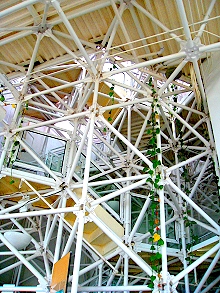
In the middle of the desert there are stairs into the bowels of the building, where we got a first hand look at the operating systems known as the “Technosphere.”
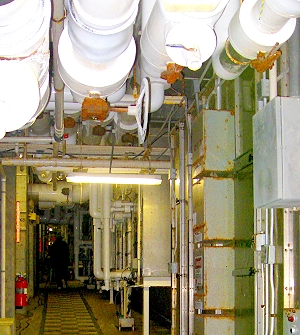
There is a baffling maze of hallways, water pipes and electrical wiring down there. Good thing we had a guide to follow as the place was getting a bit spaceshipy and creepy (think of the movie “Alien” and you’ll get the idea).
He stopped to show us one of the twenty-six “air handlers” which heat and cool the air as well as condense water from it to serve as rain or fog and replenish the ocean. That work is done on Biosphere 1 up in the atmosphere, but in number 2 it is accomplished underground.
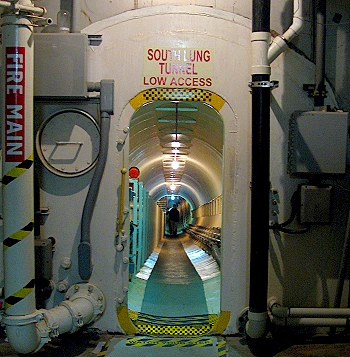
Another vital part of air maintenance for Biosphere 2 are the “lungs.” On a hot Arizona desert day, the air sealed inside the sphere would expand enough to blow the windows out.
Vents would normally allow for pressure equalization but Biosphere 2’s completely airtight system relies on these ingenious lungs.
When it gets warm in the sphere, the gigantic lungs are filled with the expanding air. Once it cools off, the lungs collapse to force the air back into the Biosphere.
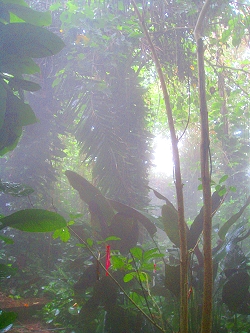
Back above ground, we found ourselves in a tropical rainforest. The biggest of the biomes, there are over 150 different types of plants living here, including several that once provided fruit for the occupants, as in pass me a banana.
With our tour complete, we decided to sneak a peek at some of the offices and labs in the old living quarters. I don’t think we were supposed to be there, but no one was around so we checked out the computer set ups and some of the ongoing experiments.
We were good, we didn’t touch anything. There is still a lot of real research going on, maybe even more than when they first locked those hippies inside. That makes this an even more exciting place to visit.
But two years locked in here? Neither of us were too big on that idea. Can anybody think of seven other people that they’re willing to be sealed in an airtight container with for two years?
We didn’t think so.
David & Veronica, GypsyNester.com

I remember watching a TV program about this – Nat’l Geographic? Discovery. It’s been awhile. I think it was at the completion of the first two years. I always wondered what happened to it. Thanks for a fascinating update!
It had a bit of a rocky mission but it was very interesting. We’re so glad it was preserved.