

Check out our Catalina Christmas getaway to the Avalon Hotel by Select Registry.
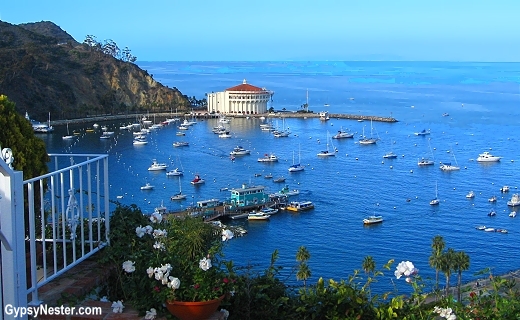
“A rose by any other name…” No doubt ol’ Bill Shakespeare didn’t know Catalina from Capulet but the little island off the coast of California sure has had its share of monikers. The Tongva, dating back to 7000 BC, lived on the island and called it Pimu.
Portuguese explorer and serial-California-stuff namer Juan Rodriguez Cabrillo dubbed it San Salvador in 1542. In 1602, Spain rechristened it Santa Catalina. Today, it’s Catalina Island or just plain Catalina.
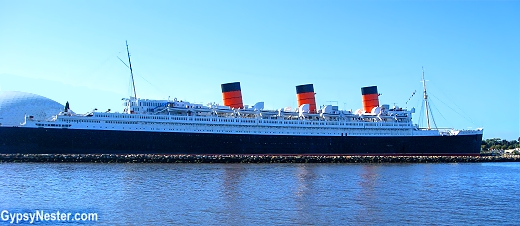
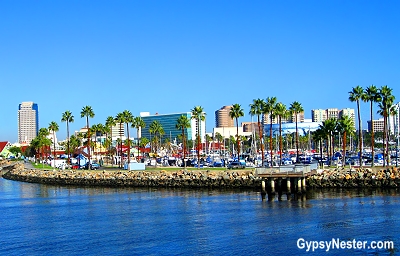
Like those early explorers, we approached Catalina by boat.
Steaming out of Long Beach Harbor past the Queen Mary we were intrepid sailors in our air-conditioned, high-speed ferry complete with snack bar, lounge and cinematic classic on the big screen.
Arrrgh, the briny deep, matey.
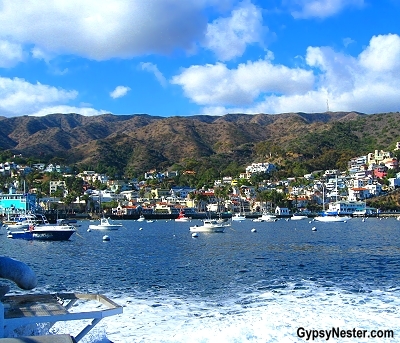
Upon disembarking by gangplank we noticed that there were cars and trucks on the roads.
WHAT?
Isn’t Catalina famous for not having any cars?
It was our understanding that this sort of vehicle was not welcome on the island.
If there’s a ban, it’s one loosely enforced sucker.
Let’s say that cars are discouraged.
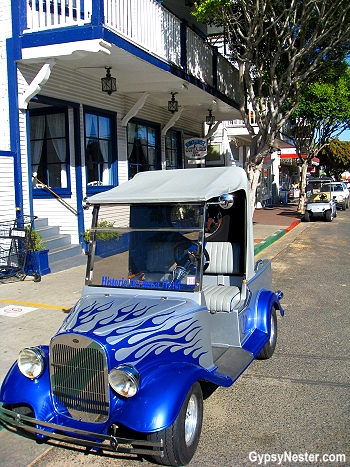
The island is fairly large — over twenty miles long — so practicality dictates that some motored vehicles are necessary.
There is limit on the number of cars allowed on Catalina at any given time, creating a ten year-ish long waiting list for the privilege.
So folks wait and drive golf carts.
Give a human any sort of vehicle and they will inevitably trick it out.
Kids add bells and streamers to their bikes, threading playing cards in the spokes for some acoustical flair.
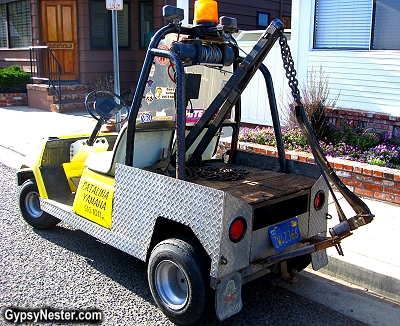
Teens will fire-ball paint their heaps and sport glass packs, chrome pipes and hot rims or, nowadays, an ear-bleeding stereo that could easily serve as a sound system for an AC/DC concert.
Midlife crisis guys get cherry red painted rag tops and Catalina folk have their golf carts.
Where do they find these pint-sized chrome wheels and accessories? Is there a “pimp your golf cart” web site out there somewhere?
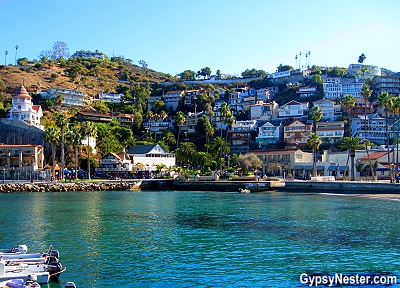
Feeling rather inadequate on our non-tricked out bikes, we nonetheless forged ahead having brought them with us on the ferry.
Catalina is bike-friendly; however, the hills are not friendly at all.
It was easy enough to ride around Avalon, the island’s only town, but level ground is nearly nonexistent everywhere else.
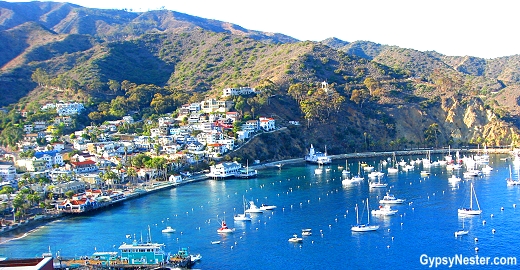
Almost all of the 3,700 residents of Catalina reside in Avalon, crowded in a semicircle around the harbor.
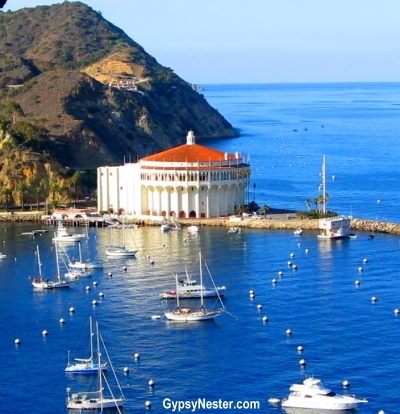
The bay is lined with restaurants and shops and dominated by The Casino – no, not a fine establishment filled with gentleman in tuxes and gaming tables, a casino as in the formal definition.
From the Italian, casa, meaning house, a casino is a building for housing civic functions like concerts and dancing.
So we weren’t off the hook in the gentleman department.
Civilized, it is.
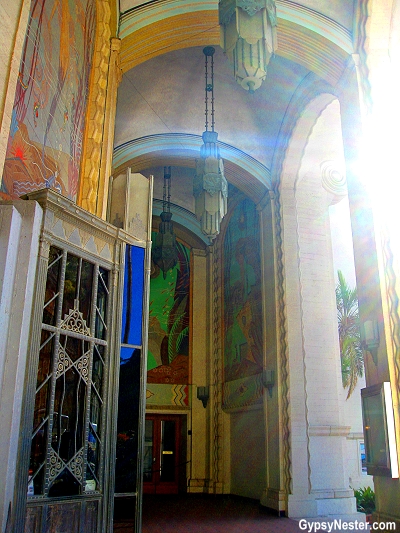
The beautiful twelve-story high, round Art Deco structure juts majestically into the sea and includes the world’s largest circular ballroom on the upper level.
Score! We love us some world’s largest stuff!
And this one was so unexpected.
The lower portion is the 1,184 seat Avalon Theater that is still showing those newfangled moving pictures, talkies even.
The Casino and many of the island’s other most prominent structures were built in the 1920s by chewing gum magnate William Wrigley, Jr.
After buying the Santa Catalina Island Company in 1919, plans immediately began to promote Catalina as a tourist Mecca. The gum man even purchased two ships to ferry folks out to his friendly little Shangri-La.
We rode our trusty bikes up Avalon Canyon Road, passing the site where Cub Spring Training was held from 1921 to 1951, to the Wrigley Memorial and Gardens. Wrigley also happened to own the Chicago Cubs.
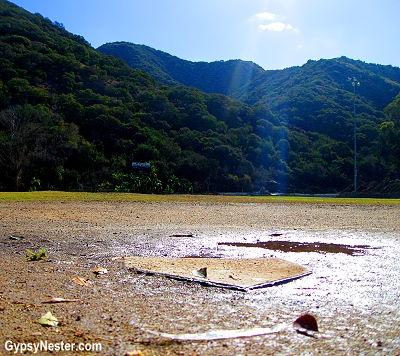
He made the decision to have the Cubbies spring training on the island — and it must have put some pepper in their play as it was during that time that they won their last pennant.
Hmmm… rather than blaming the Curse of the Goat, the Cubs should hightail it back out to Catalina.
‘Cause, damn, it’s just getting embarrassing.
A 130-foot high memorial was built to honor Wrigley after his death in 1932 and the surrounding thirty-eight acres were set aside as a nature conservatory.
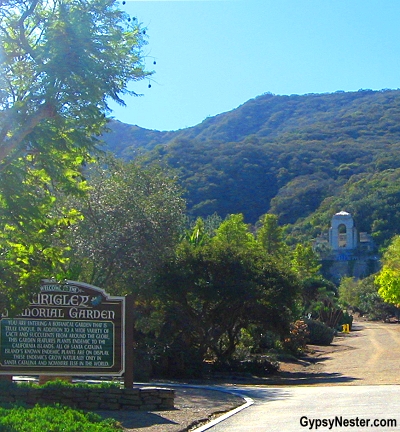
Pedaling up the steep road was a slow go — the passing golf carts seemed to whiz by at a rubber burning 15 or 20 miles per hour.
Nothing like a rented souped-up golf cart to bring the inner wild man out in a tourist — we had to smile every time a laughing bunch zoomed by as we labored.
At the top we took a break to enjoy the view and the many examples of flora and fauna preserved in the gardens.
Living harmoniously with the indigenous island animals are celebrity bison. These burly buggers were brought over for a movie in 1924, left behind, and now thrive in the preserve.
The Wrigley Memorial Garden Foundation places special interest on protecting the native endemic plants Catalina Ironwood, Catalina Mahogany, St. Catherine’s Lace, Catalina Live-Forever, Catalina Manzanita, and Catalina Bedstraw.
These species don’t grow any place else on Earth.
A breathtaking panoramic view spread out before us as we coasted back down the canyon road — giving the old brakes quite the workout.
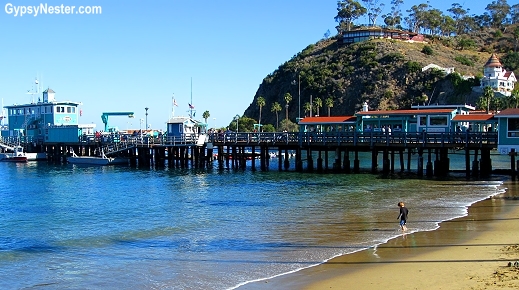
By the time we reached Avalon the shoes were smokin’ so we dismounted and strolled the waterfront and The Green Pleasure Pier.
The pier is the place to find tour boats, glass bottomed and otherwise, grab a bite, shop for fishy souvenirs or just soak up some sun.
Content with solar soaking, we whiled away the remainder of the afternoon listening to the waves lap at the sand, the gulls calling overhead and the puttering electric hum of golf carts.
No question of whether to be (or not to be) here.
David & Veronica, GypsyNester.com

Hi there! Such a wonderful article, thank you!
I’ve spent many happy weeks at a private camp on this island, and my young son actually petted one of those bisons while on a hike and lived through the experience. He’s always been good with animals, but my husband almost had heart failure when this happened. I preferred our camp to busy Avalon. No tourists, just deer and an occasional wild boar running through a cabin.
We did take the island tour one year and really enjoyed it.
We had a similar bison encounter in Yellowstone. Close enough to pet but decided to back away.
Loved this! As a young’un, we’d head to Catalina every couple of years with the family. It’s been far too long since I’ve been back, but it doesn’t look like it’s changed at all! Okay, maybe the golf carts are cooler, but other than that… 🙂
– Rob.
It doesn’t change much, but it is still worth a trip back.
We took a trip to Catalina about six years ago now and we really enjoyed it there. There’s quite a lot to do and if we were to go back, we’d apply for camping permits to do some hiking in the interior.
That sounds like a great idea Jennifer!
the golf carts and general pace just about force you to slow down and enjoy! That’s speaking from experience.
And that’s a good thing! (as Martha Stewart would say)
Beautiful photos, especially of the water! Funny bit about the golf carts. It definitely adds to the place’s character!
Thank you Mary!
Love your Empty Nester and Catalina stories today. Luvin my fellow boomers. lmao!
Thanks for the boomer love! 😉