

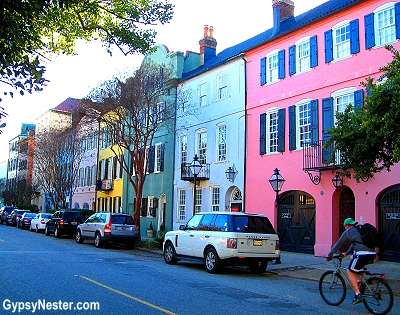
We didn’t really have a destination in mind other than south to escape the winter.
Veronica had never been to South Carolina, and we were both intrigued by the town of Charleston, so we headed for the coastal “Lowcountry” and discovered one of America’s most interesting cities.
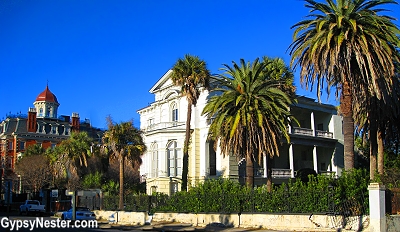
Originally called Charles Towne way back in 1670, after the Revolutionary War when the British left, the name was officially changed to Charleston in 1783.
Remarkably, it looks much as it did back then.
A phenomenal amount of the colonial structures remain, and most have been restored to like-new condition.
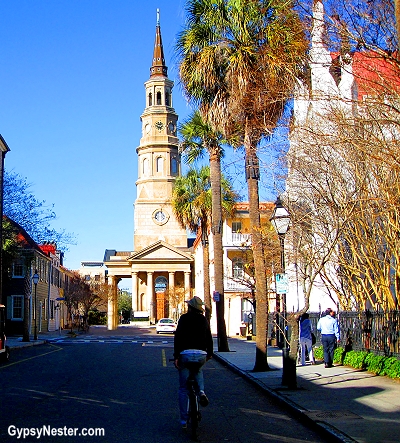
To get a closer look at these gems, we knocked the dust off of our trusty bikes and cycled into the heart Charleston’s historic district.
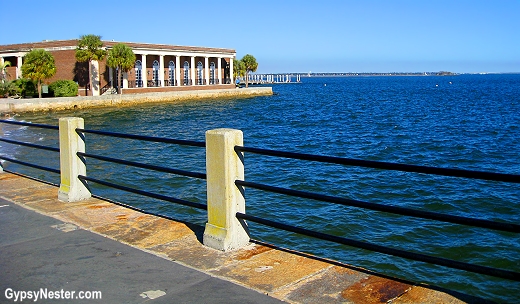
Highlights of the district included The Market Hall and Sheds, known simply as the Market, built in the 1830s, Battery Park with its cannons, the promenade, and a plethora of churches.
In Charleston steeples, not skyscrapers, form the skyline.
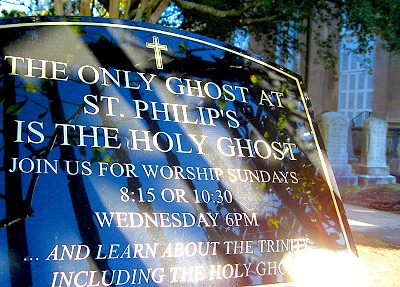
Charleston is sometimes called “The Holy City” in recognition of all those churches, as well as being one of the few cities in colonial America practicing religious tolerance.
In fact, it was one of the first to allow Jews to openly practice their faith and, until the 1830s, boasted the largest Jewish community in North America.
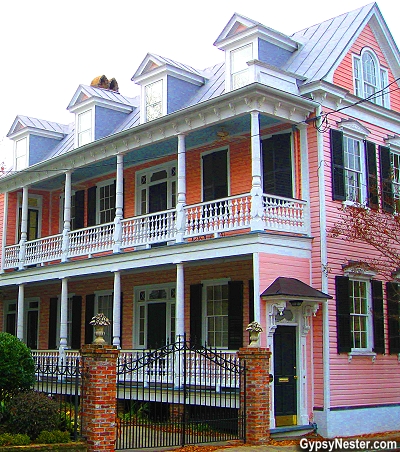
Something else stood out to us as we pedaled around – many homes had odd doors facing the street leading to outside porches.
Having never seen such before, we dubbed them “porch doors,” and tossed around quite a few theories as to why they existed before finding out their true function.
Known as hospitality doors, these portals were a way of communicating with friends and neighbors.
Leaving the door open meant the occupants were home and ready to receive guests and offer up some good old southern hospitality. Possibly with a mint julep on the veranda.
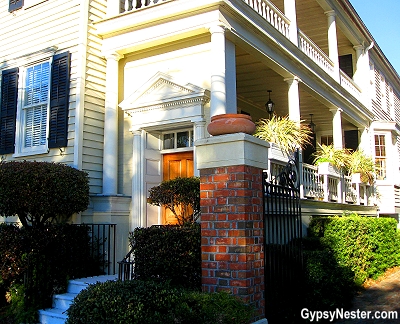
We would have been on the lookout for open doors if we had known this fact ahead of time – who knows what we missed out on.
Hospitality doors are a staple feature of the colonial style homes known as the Charleston Single, unique to the city.
The houses were situated perpendicular to the street with the porch facing sideways. This allowed for maximum outdoor living space, more cross ventilation and, more homes fit on longer, narrow lots.
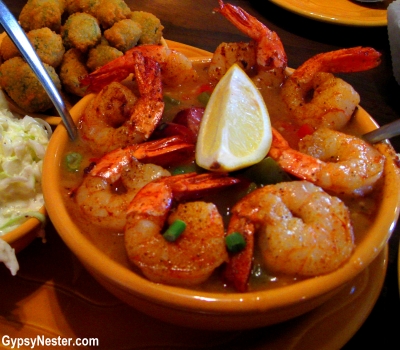
After a quick pit stop for some shrimp & grits, a Lowcountry favorite, we happened upon the campus of Charleston College, right in the midst of the historic old town.
Talk about historic – the college was founded in 1770 – C of C is the oldest municipal college, and 13th oldest college of any kind, in the United States.
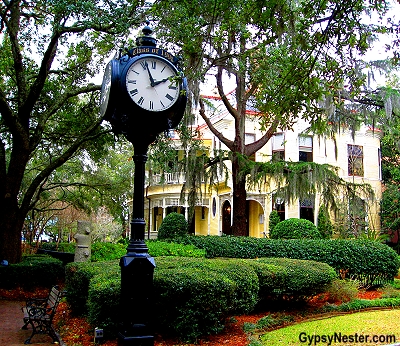
Three of the school’s founders signed The Declaration of Independence and, three more, The Constitution.
Through the years the campus has grown and now incorporates some amazing stately old mansions.
Hope these young whippersnapper students appreciate their surroundings – with its Spanish moss draped trees and elegant architecture, it is the most beautiful campus we’ve seen.
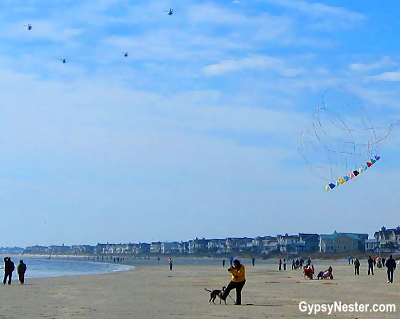
The old city is packed tightly onto a peninsula in the harbor, so to get to a good stretch of beach we needed to get out of town.
On the nearby Isle of Palms, it wasn’t warm enough for swimming, but plenty of folks were out enjoying the gorgeous day.
Turns out it was also the perfect day for military helicopter maneuvers and kite flying.
And we may have found the kite king. Anyone who can fly a dozen kites attached together has got to be royalty. He finds pure joy making the strangers around him happy!
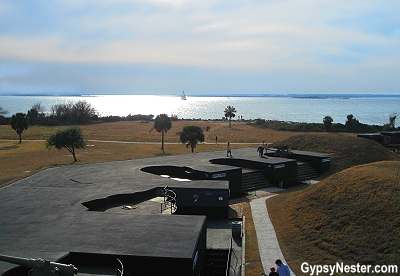
Just a hop, skip and a jump closer to Charleston from The Isle of Palms is Sullivan’s Island and Fort Moultrie National Monument – the best place to view Fort Sumter from dry land.
Fearing an impending attack from the Brits in 1776, Fort Moultrie was the first of Charleston’s many fortifications.

The fort was originally built of Palmetto tree logs because the trees were readily available and the colonists were in a hurry.
This turned out to be a stroke of incredible luck though, since the palm logs are soft and rubbery.
When the British attacked, their cannon balls pretty much bounced off the fort doing little damage. The King’s navy was held at bay, and South Carolina became known as The Palmetto State.
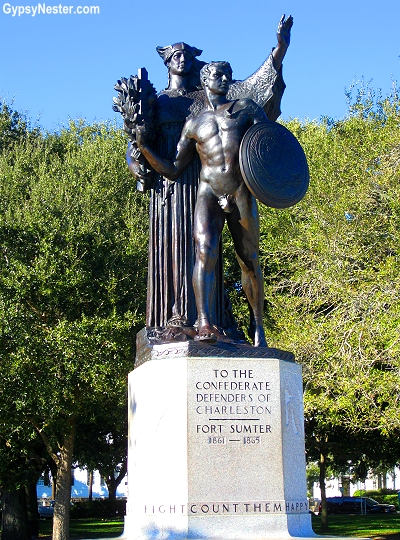
Fort Moultrie went on to see service guarding Charleston in every conflict through World War II, including firing some of the first shots of The Civil War, when General Pierre G. T. Beauregard fired on the Union.
In the Visitors Center, exhibits detail the nonmilitary history of Sullivan’s Island as well.
The Island was the largest slave port in North America, with over two hundred thousand shackled people passing through.
Almost half of all African Americans have an ancestor forced to disembark there, a kind of reprehensible version of Ellis Island.
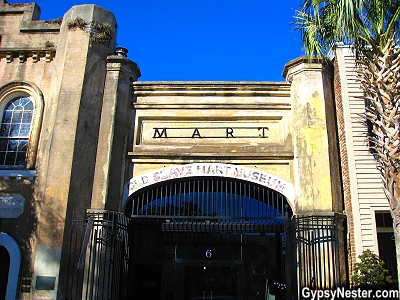
Once onshore, the enslaved Africans were mostly left to themselves on these coastal islands, since the plantation owners feared diseases and wanted to live in the city.
A unique culture and language developed on these sea islands in The Carolinas and Georgia known as Gullah.
We wanted to know more…
David & Veronica, GypsyNester.com

We’ve been in Charlesron for the last 5 days, Veronica! Old, dear friends live here. This is our third visit. Craig & our friend flew 3 different kites at Sullivan’s Beach yesterday! Love it here! ❤️
It is a great town. Safe travels.
I’m heading to Charleston for the first time in a few months…thanks for the great info!
Glad we could help Denise, have a great trip.
Looks like it would be fun to cycle around Charlestown’s historic district. And it sounds like you can get some great shrimp and seafood dishes there!
Most certainly!
Hi guys, My wife and I went to Charleston on a bucket list vacation. It was actually part of the inspiration for my Blaycation Bucket List Vacation business. We were on tour there sampling all the great restaurants and vibrant culture and sights and sounds of the city just prior to me ticking off my Myrtle Beach marathon. It’s a very warm and inviting city with a great market, local interesting businesses and shops to get lost in and amazing restaurants. On top of the colonial and southern charm it’s an absolutely beautiful waterfront city too. If you get a chance to eat at Husk, try the Pigs ear lettuce wrap app. they were outstanding. Thanks for sharing.
Pig ear wrap… that’s a new one. We’ll have to try it.
We are big Charleston fans. Love it even more than Savannah, GA. Thanks for all the detail in your post! Can’t wait to go back and see more!
We need to make a return trip ourselves sometime.
Great article – I want to go there now!
Thanks, it is definitely worth a trip.
An excellent article. Thanks for opening the hospitality door to Charleston.
Our pleasure.