

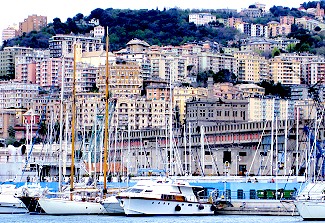
When we hear the name Genoa it harkens thoughts of dry salami.
That’s SO not what this city is all about. Our latest Italian adventure would open our eyes to an often overlooked
region of Il Bel Paese (The Beautiful Country) — the Italian Riviera along the Ligurian Sea.
Click for Genoa’s Ancient City Photos
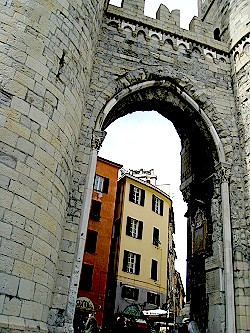 We decided to begin our explorations in the oldest section of the city. As with many towns in ancient times, walls were built to keep out the invading hordes.
Within those walls, the old city of Genoa (or Genova to the Italians) is the biggest and one of the best preserved in all of Europe — and is currently a bustling community filled with charming restaurants, shops and residences.
The ancient buildings and narrow cobblestone streets survived the World Wars much better than most and is in a constant state of renovation. It takes a lot of work to keep a place like this up to snuff.
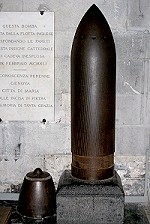
It’s not that Genoa was never bombarded, her harbor has taken some severe beat-downs, but her old city remained fairly unscathed.
One might even speculate that there was divine intervention because the Cathedral San Lorenzo proudly displays an unexploded bomb that had miraculously spared the church.
Sure glad this ominous projectile was a dud — the cathedral is such a unique architectural specimen — its loss would have been tragic.
Hopefully the priests of San Lorenzo were expert bomb diffusers — we would hate for their incredible luck to run out while we were snapping a photo.
 Click for more San Lorenzo Photos
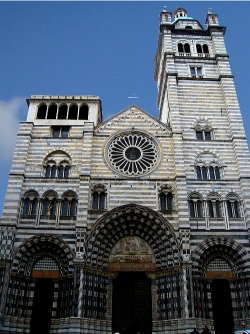
The plaza facing San Lorenzo is so small that Veronica had to lie supine with her head propped on an opposite building to capture a partial photo of this wonderfully quirky cathedral.
Tight as the plaza is, musicians, street entertainers, balloon artists and art students crowded the steps and cobblestones.
The public is not permitted to tour in the middle of the day, so we whiled away a few hours inspecting the magnificent exterior and watching tourists boorishly climb atop the church’s marble guard lions for snapshots as if at Disneyland.
Italians rightly expect decorum — this is a place of worship, after all — appropriate dress is mandatory and even the school children use polite hushed tones while visiting.
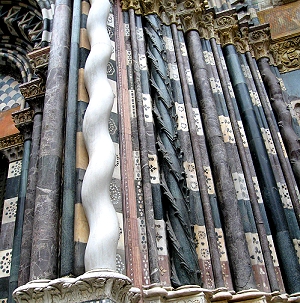
Click for more San Lorenzo Photos
San Lorenzo began as a small church in the fifth or sixth century and was rebuilt several times before being consecrated as Genoa’s main cathedral in 1118.
As is often the case with medieval churches, the construction continued for centuries incorporating numerous architects and styles throughout the years.
The facade, with the black and white layered stripes of marble and slate is typical of this area, was finished in 1312.
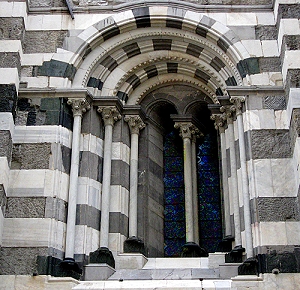
An asymmetrical window on the south side of the church stopped us in our tracks.
Approaching from the front, nothing seemed amiss, but once we stepped back a few paces we discovered the window had a decidedly lopsided skew.
Between it and the bizarre unmatched columns, we were in heaven. We love that kind of stuff.
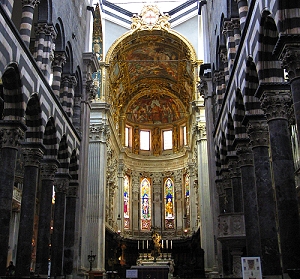
The final touches inside San Lorenzo weren’t completed until the seventeenth century. It’s a wonderful display of a mishmashed styles.
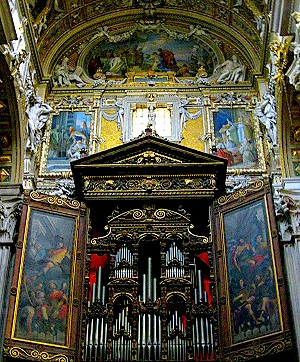
Black and white continues to dominate the decor, yet the altar area and the pipe organ are bright and colorful — the contrast strange and wonderful.
From the cathedral we went in search of Genoa’s most noted native son, Christopher Columbus.
We had heard that his house was still around so we headed toward the eastern edge of the old city, googling on the go.
 Christoffa Corombo, as he was known in the 15th century Genoese language (a dialect that is still in use today), was probably born here in 1451 but almost certainly NOT in the little tourist trap house by the Porta Soprana.
We decided to skip the house since our research revealed that it probably wasn’t built until long after the celebrated sailor had set sail on that great ocean in the sky.
It’s possible that it was built on top of Christopher’s OLD crib but that’s still about as likely as sailing to India from Portugal by going west.
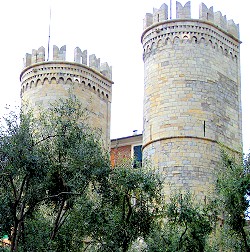
On the other hand, the towers at the Porta Soprana are more than worth a look.
Built in 1155 when the city walls were renovated, the two towers stand 100 feet high and frame the eastern entrance to the historic center of Genoa.
A fine example of medieval fortification if there ever was one.
Walking through the Centro Storico we realized that, although his house is a fake, the man known here as Cristoforo Colombo had a huge impact on this city. Before he gallivanted off in search of India, Genoa had lost a little of its luster.
Wars, pestilence, and foreign dominance had taken a bit of the spice out of the salami.
Even though Columbus discovered the treasures of the New World for the Spanish Crown he didn’t forget his hometown. He deposited his money in Europe’s –perhaps the world’s — first public bank, The Bank of St. George (Banco di San Giorgio) in Genoa.
He also donated one tenth of his earnings toward tax relief for the city.
Genoa became Spain’s banker and piles New World gold and silver started flowing into her coffers. Presto, the return of the spicy cold cut.
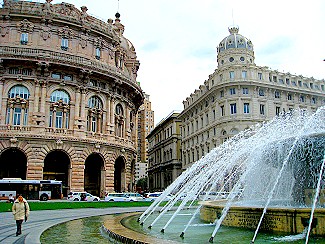
There are still remnants of those financial glory days, mainly around the Piazza De Ferrari.
The piazza is dominated by a huge fountain in the center, surrounded by majestic buildings including the regal Palazzo Ducale, the Stock Exchange and several wildly ornate banks.
The Palazzo was home to the Doges (dukes) of Genoa for over 450 years until Napoleon took the city in 1797 and it was stormed by soldiers and mobs. The Palazzo is now a museum and, happily, the mob has moved on.
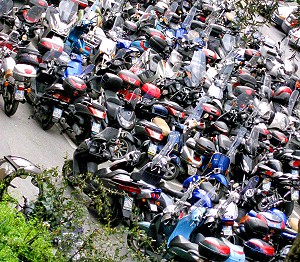
It seems that new, modern mobs have overtaken Genoa.
Vespas!
Other than perambulating they are the conveyance of choice and the only vehicles allowed in the ancient city.
It may not be the sea that Columbus knew — but it is a sea nonetheless –a sea of scooters. Not an ocean that ole Chris would recognize but then, he went to his grave believing that the Caribbean was India, so perhaps recognizing things wasn’t his strong suit.
Just so happens that David’s band mate Paolo‘s Mama lives in Genoa and like most Italian Mamas, the woman can COOK. We were invited to do something that we do well, eat! How’s that for synergy?
The restaurants in Italy are almost universally fantastic — but home cooked meals generally open up a whole new universe.
Unmatched care and hospitality are given to every aspect of the dining experience and the taste buds benefit bountifully.
Genoa is known as the home of pesto, it was invented here. And guess what we were having for dinner?
This was not to be a typical Italian meal but more a traditional Ligurian dinner. Handmade gnocchi with the classic basil and garlic pesto was the centerpiece while focaccia, cheeses, vegetable pastry, salad, gianchetti and various vinos rounded out the scrumptious spread.
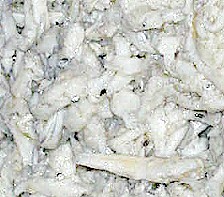
One of the many advantages of visiting an Italian home is the opportunity to try dishes not available or that we would never order in a restaurant.
Gianchetti is a fine example, since we can’t recall thinking “I wish we could find some tiny blanched anchovies.”
Yup, little bitty boiled baby anchovies — complete with their little bitty boiled eyes — not bad actually, just odd.
Mainly we just wondered why they didn’t wait to let them grow up because a full grown anchovy can certainly rock on a pizza pie.
Guess we’ll have to head down to Naples for that — not that we need any excuse to eat our way across Italy.
David & Veronica, GypsyNester.com
See also:
Genoa’s Ancient City in Pictures
More Photos of Cathedral San Lorenzo
Thanks for the excellent post
This is truly useful, thanks.
Genoa is on my bucket list. Great story as usual.
Thanks, hope you make it there, it is a great city.
When were you last in Italy, Genoa is indeed one of Italy’s lesser know cities.
Spent a week in the north last July, including the fantastic city of Genoa.
Hi!
I went to Genoa for a particular reason – I’m writing a book about Andrea Crestadoro who was born there (1808-1879)- inventor, indexer and last part of his life, Chief Librarian of Manchester.Totally obscure character but fascinates me. I loved Genoa -I could only spend a few days there but what a place to explore. Sadly I could not track down the model of one of the inventions – the Impulsoria – which is supposed to be in one of the museums. If anyone saw it please let me know! (If you search on Crestadoro/Impulsoria, you’ll find more information).
Anyway your site is brilliant – came across it because I was looking for info on Ovada,
Best wishes
Lucy
Genoa is a gem, no doubt. We are not familiar with Crestadoro, but sounds like we aren’t alone in that. Hope you find the model!
-The GypsyNesters
For some reason I’ve always managed to skip right past Genoa, too. You do make it sound interesting, though. Think I’ll stop and have a look next time.
Of all of the time I have spent in Italy, Genoa has always escaped my attention. I would love to visit though. I remember reading somewhere about the bomb not going off and sparing the church. What a miracle story!
It is most certainly worth a visit.
When I read your blogs, it is like taking a trip to a place that I would love to go. Thank you so much for sharing.
Ah, it looks amazing. We've been to Rome, but there are so many other places we want to see, including this one.
The Amalfi Coast looks breathtaking, Milan, Florence, Naples, Venice, Sicily… I could go on. 🙂
Thanks for sharing your write-up and beautiful pictures.
D & V; I just watched the video of your visit with the folks in Genoa. Loved watching your experience in the kitchen with your hostess; it reminded me of our visit with cousins in Umbria last summer. I speak about as much Italian as you do, so now I don't feel so awkward! ;-D Haha.
Most special to me, though, is the recipe for Buneta!! My grandmother used to make this delicious custard, and I've been looking for it for years! Thank you, thank you for sharing the recipe, I can't wait to try it. BTW; my Nonnie's special touch was to add powdered instant coffee in with the cocoa powder–oh, it was unforgettable!
You guys are the best! Keep on travelin'.
Terry,
Glad we could bring back good memories. The coffee idea sounds yummy!
Thanks, and you know we will keep right on going.
-Veronica
"little bitty boiled anchovies" Who would have thought they could be tasty after boiling – only the Italians. I enjoy Italy so much, thanks for the article and great photos!