

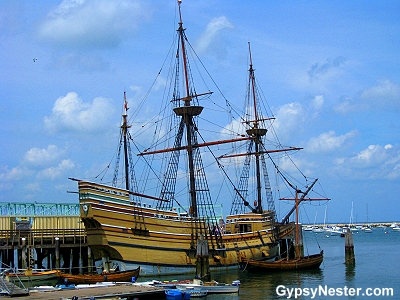
True story: On our pilgrimage to Plymouth, Massachusetts we stopped off at the visitor center to ask directions to Plymouth Rock.
“Hope you guys brought a magnifying glass,” snarked the lady with the welcoming smile behind the desk as she pointed down the road. Ah sarcasm, we had to like her.
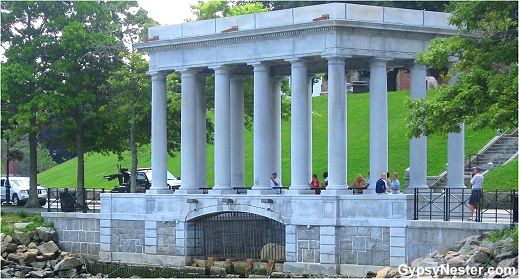
Without fully grasping the gist of the lady’s statement we headed across the road, past the replica of the Mayflower, toward the attractive ancient- Greek-esque monument that houses the famous rock where the first Americans landed.
Giddy with the exhilaration that can only come from setting one’s eyes on a truly epic piece of history, we leaned over the rail and peered down into the hole where Plymouth Rock is displayed.
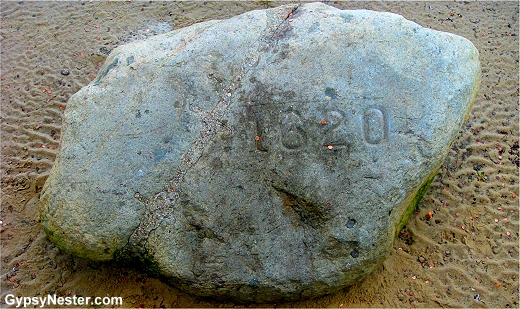
Holy crap! The thing is TINY!
Only one pilgrim with REALLY GOOD BALANCE could “land” on this pebble! Call us gullible, but we always figured that Plymouth Rock was towering cliffs, or at the very least, hefty enough that the Mayflower could tie off to it. We were flabbergasted, felt duped.
Thankfully people had thrown pennies at it, for luck we suppose, giving us
some perspective for a photo.
Turns out that almost everything we were taught in grade school about the
pilgrims and the first Thanksgiving — while we were drawing turkeys from the outlines of our hands — was a complete fairy tale.
The “friendly Indians” were actually just so emaciated and weak from the
smallpox they had contracted from previous European visitors that they had no strength to fight off the Pilgrims who were busy raiding their food supplies, digging up their graves and squatting on their fishing grounds.
Wait a minute, previous visitors?
Yup, the Pilgrims were no where near the first settlers in New England. Europeans had been tromping around stealing food and spreading disease for decades — centuries if you count
the Vikings.
At Plymouth, a few leaders of the depleted remnants of the local tribe of Wampanoag people decided to employ the old “if we can’t beat them, join them” strategy in the hopes of surviving.
Not quite the “hey, welcome to America, here let us show you how to grow corn and eat turkey” that we were taught as youngsters while sporting our construction paper feathers and headbands.
The first time around wasn’t even remotely friendly. The Mayflower first landed on the tip of Cape Cod, where Provincetown is today. There’s even a huge monument marking the landing.
However, the indigenous inhabitants had not been wiped out by viral onslaughts from previous pioneers and were not real big on having their buried food stores dug up and stolen, so they were decidedly unfriendly and sent the Pilgrims packing.
Just a dad-blame second there hoss, first landed?
Everyone knows the Pilgrims first set foot on North America at Plymouth! We’ve seen the pictures. There they are, stepping out of the boat right onto Plymouth Rock.
Wrong again, fact is there wasn’t even such a thing as Plymouth Rock until over a century after the Mayflower’s landing. It wasn’t until 1741, 121 years after the Mayflower landed, that 94-year-old Thomas Faunce claimed he knew the exact rock that the Pilgrims first trod upon. A few years later, in 1774 the townsfolk decided that the rock should be moved to the town meeting hall.
For no apparent reason, the good people of Plymouth decided that only half of the rock needed to be relocated, so they split it in two. For the next century, the rock was moved hither and yon as chunks were hacked off of it for shows and souvenirs.
Finally, in 1880, with only about 1/3 of Plymouth Rock remaining, the famous stone was returned to its original spot on the waterfront in Plymouth. It was at that time that the number 1620 was carved into it.
Not surprisingly, Native Americans don’t tend to hold Plymouth Rock in high regard. Twice, in 1970 and 1995, activists have buried it on the National Day of Mourning or what is more commonly known as Thanksgiving to us nonnative folks. Seems that the folks who wrote our grade school history books and the original inhabitants of this country don’t quite see things eye-to-eye.
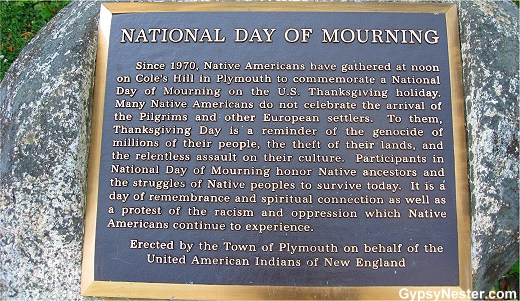
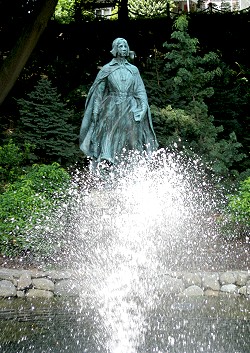
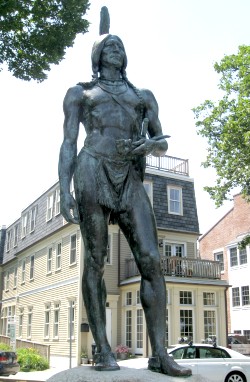
Across from the Plymouth Pebble Monument, near a statue of Massasoit
(one of the “friendly, helpful” Native Americans), is a plaque commemorating the National Day of Mourning. Given by the town of Plymouth on behalf of the United American Indians of New England, it states, “Thanksgiving Day is a reminder of the genocide of millions of their people, the theft of their lands, and the relentless assault on their culture.”
It’s not fancy, but it is a nice gesture.
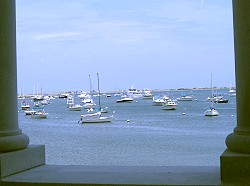
Scattered around the charming little seaside town of Plymouth are various statues and fountains, pretty parks, seafood based eateries and crap shops (GypsyNester slang for fine souvenir emporiums) selling the ever zany pilgrim-pirate-patriot humor t-shirts, lobster bibs, mugs and ships-in-a-bottle.
Once finished with our tour of revisionist history, we relaxed at an outdoor café — sharing a lobster roll — as the ocean cast friendly breezes to tussle our hair. The fake Mayflower shared a bay dotted with sailboats and pleasure cruisers. We stretched our legs and tilted our faces to the sun.
It’s no wonder the Pilgrims and Indians loved this place so much.
David & Veronica, GypsyNester.com
That is a really great story! And one that isn’t told. You can see how the Greek legends arose can’t you – they were ‘historical facts’ at some point too, I’m sure.
Hadn’t thought of myths like that before, great point. Thanks.
Wonderful review of our ‘historical’ Plymouth and its rock. I lived in NE for ten years and never visited, because, overall, size DOES matter! (Just kidding, but I knew the history and I don’t blame the American Indians for having a day of mourning. Finally in the schools students are being taught a more realistic idea of life in early colonial times.)
The more we look into history, the more we discover that some of it is really just stories that have been passed down, not necessarily in line with all of the facts. But it is fun to keep looking.
This is hilarious and fairly typical about how history is ‘interpreted’ to suit whomever. Great story from fabulous story tellers
History can have an interesting point of view. Thanks!
The victors are the ones who write history. Besides, no one today has any idea how hard it was to survive in the new world for people fresh off the boat. The fact Europeans raided Indian lands and fought them off doesn’t make them monsters. For example, there is archaeological evidence that the people of Jamestown resorted to cannibalism for survival. Any one of use would do the same “horrible” things the colonists did if the alternative was death. Besides most Native Americans were at war with settlers by default. I don’t blame any colonist for the things they did against the Native Americans. Its only recently that people have spread propaganda among Americans that there ancestors were evil racist monsters. Don’t listen to those lies.
That’s so funny…I had visions of something like the Rock of Gibraltar – LOL
No kidding! We did too.
it’s about time our children are taught the truth about “thanksgiving”..it’s time to confront the truth and give up the myth..we wonder why we have become so dumbed down, it is no wonder, education is the reason..let’s start teaching the facts and leave the fairy tales aside
>JaneNation went there last year on our listening tour, Isn't it tiny?!
>We were amazed at it too. I was expecting a huge rock at water's edge where the pilgrims docked their boat. Not exactly one of the seven wonders. 😉
>Hope you've read the book Mayflower. It is gruesome but true story of some of my ancestors behavior. (I'll admit though, the first generation was okay, it was the kids that were bad. And Secodly, I hope you toured Plymouth Plantation. Much more tasteful and true to life than the Plymouth crap shops.
>OMG…I have rocks bigger than that in my garden!