
With All Hallows Eve fast approaching, we decided to revisit this visit to one of America’s scariest cities… Salem, Massachusetts. Happy Halloween!
We fully admit we were drawn to Salem by its sordid past.
However, we were horrified to find that tourist trap economics trumped the unseemly historical facts.
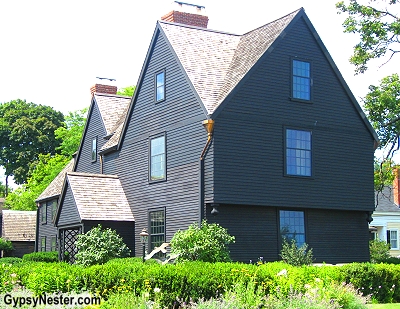
There are plenty of wonderful nonfictional sites in the beautiful seaside town, including the famous House of Seven Gables that Nathaniel Hawthorne wrote of (go there — the hidden passage alone is worth the price of admission!)…
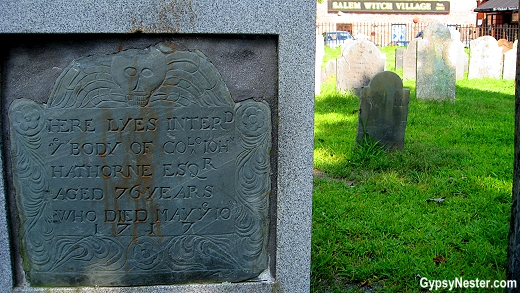
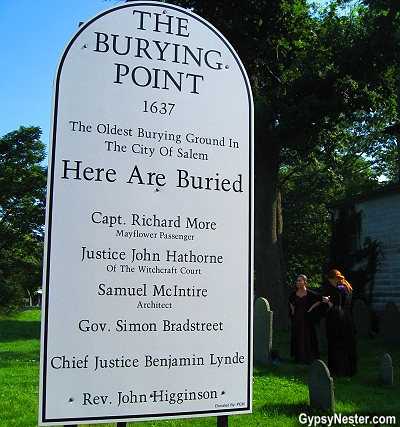
…and the old cemetery where several Mayflower passengers and many of the participants in the witch trails are laid to rest.
Nearby, there is a memorial to the victims of the trials.
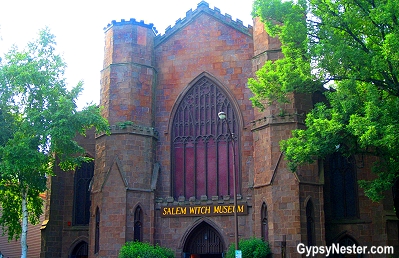
The Salem Witch Museum, housed in a church built and used in the 1700s, is one of the few museums in town that actually embraces a factual account with minimal sensationalism.
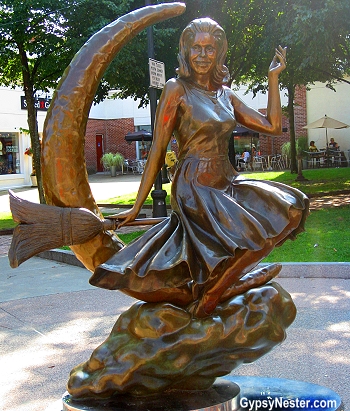
The bulk of the attractions run toward more Halloween-style stereotypes.
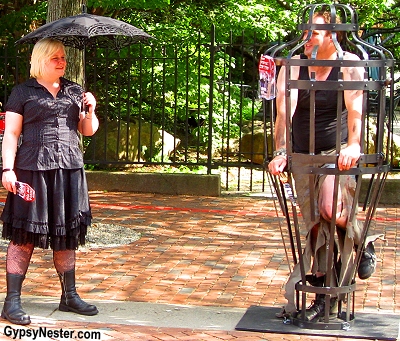
The wholesale killing of dozens of innocent men, women and children has mutated into an excuse for throwing up goofy Frankenstein and Dracula “museums,” wizard schools, ghost tours, bizarre street theater and a cheesy statue of Samantha from Bewitched.
No kidding.
Salem, Massachusetts and witches are nearly synonymous but, in reality, it is highly doubtful there was any broom-flying, cauldron-stirring, pointy-hat-wearing witchcraft actually going on back in 1692.
It seems a few young girls began to act strangely that year. Whether they were sick, drugged by fungus-tainted grain, or just looking for attention — we’ll never know.
The Puritan minds of the late seventeenth century figured that the convulsions they suffered could only be caused by witchcraft.
Time to round up the usual suspects.
On March 1st, a beggar woman, a slave girl and a lady who dared not regularly attend church services were hauled in and charged as witches. These three accused others and before long no one was beyond suspicion.
Within a few months, sixty-two people had been arrested.
By summer, the God-fearing folks of Salem were hanging folks on no more evidence than a few accusations, coerced confessions, and the good old “touch test.”
By the time September rolled around, twenty people had been put to death. Many more died while in prison awaiting their trials.
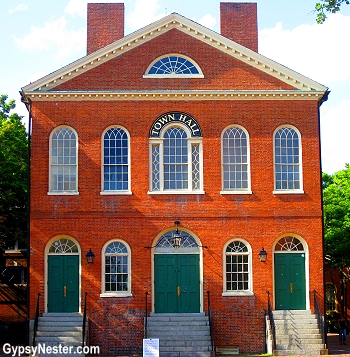
When eighty-year-old Giles Corey was arrested, he refused to enter a plea — as a protest against the court’s methods.
Rather than hang Mr. Corey for daring to point out that the sanctimonious kangaroo court had run amuck, the pious Puritans decided to go with torture.
Rocks were stacked on the octogenarian until he couldn’t breathe. Giles, being a true bad ass, survived for two days.
He never entered a plea.
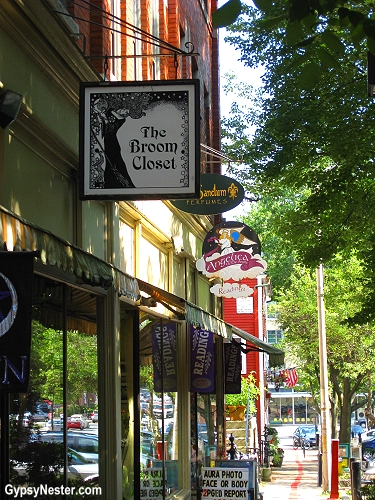
Perhaps old Giles Corey didn’t die in vain. By October, a few voices of opposition had begun to question the proceedings.
By month’s end, the Governor had prohibited further arrests and dissolved the court.
On closer inspection, the real reason for the hysteria and brutality in Salem likely stemmed from a religious squabble between rival factions in the church, and political pettifoggery between neighboring villages.
What better solution is there to solving differences than to hang people as witches?
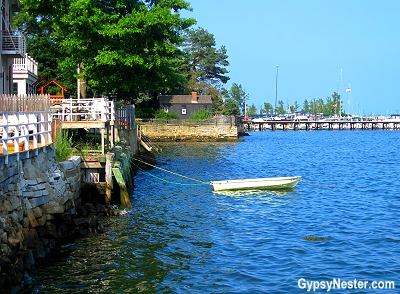
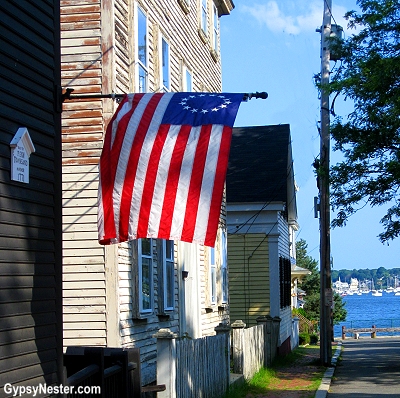
Altogether overshadowed by its infamous witch-related history is the fact that Salem was once one of North America’s main seaports.
The colony’s early trade developed into huge business, mostly with the Far East.
Thankfully, the old harbor is being preserved by the National Parks Service as the Salem Maritime National Historic Site.
Many of the buildings are being refurbished and informative signs provide a guide while strolling along the gorgeous bay.
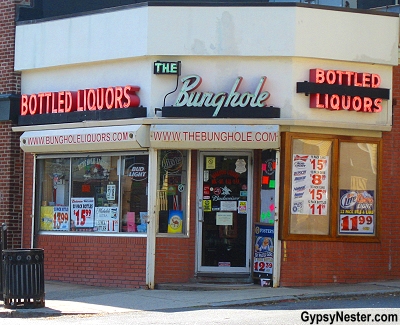
Directly across from the harbor we noticed a liquor store with a name that was a nod to Salem’s old seafaring days — The Bung Hole.
Our only previous experience with the term “bung hole” had been as a slang term for the termination of the alimentary system, you know, the pooper, A-hole, bum, gluteus maximus, OK, OK…. butt.
But, it turns out the term actually refers to the hole in the booze barrels that the ships used to haul, which is plugged with a stopper called a “bung,” hence, the bung hole.
This fine establishment seemed intent on educating the startled tourists with clever pictorial explanations, showing pictures of barrels and ships.
But their jig was up when we discovered the T-shirts with “I Got It in the Bung Hole” emblazoned across the chest!
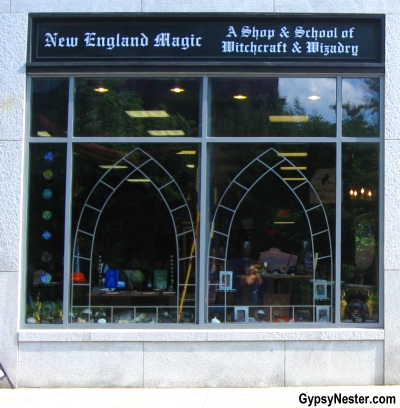
Though there is no evidence that real witches were conjuring up spells way back when, the modern variety have fully embraced Salem and are Wicca-ing away throughout the town.
Dare we say it has become the Wicca Mecca? Sorry about that.
On one hand, this proves the progress of tolerance made in Salem, but let’s hope it doesn’t detract from actual history and overshadow the real lesson to be learned from the Puritan mindset of the 1690’s…
…don’t ever let it happen again.
David & Veronica, GypsyNester.com
Intresting read
Thanks!
Pretty frightful picture, however on the other hand, it affirms my overall perspective on coordinated religion.
Thank you for all your efforts that you have put in this. very interesting info .
Very intresting
A pretty horrid picture, but then again, it confirms my general view of organized religion. And now that hysteria is being used to make a profit — which is, of course, the modern religion …
Being from Massachusetts, I have been there many times. When I was younger, it wasn’t so commercialized. But now they take advantage of the negative notoriety and have some fun with it.
Have you ever visited the Lizzie Borden Museum in Fall River Massachusetts?
Len
I suppose the new TV show will only add to it. No, we never have been to the Lizzie Borden museum, familiar with her story though. We’ll have to check it out if we are through there someday.
It’s always a shame when somewhere with such an interesting (/horrific) past gets commercialised like that. Thanks for the information though, I’ve always found this sort of history fascinating.
The real story is fascinating, as is the study in human nature that is what it became, I suppose.
Sorry to hear Salem is so cheesy, but also grateful for your guide to those spots that are more “real”. The play, Crucible by Arthur Miller is one of the best introductions to the true happenings of the Salem Witch trials. He wrote it in reaction to Senator McCarthy’s “witch hunts” of communists in the 50’s.
You’re right, the Crucible is great. Need to watch it again.
Great article! This has been a topic of interest to me since I was in grade school. I’ve heard a lot of theories as to the whys and wherefores. This is the first time I’ve heard of the warring for power/money/religion angle. It makes the most sense (if one can make sense of wholesale slaughter and murder) and seems the most probable.
It’s a shame to learn that an area of such historical importance has turned into a cartoon cash-cow.
Speaking of cartoons; wasn’t the alcoholic court jester in ‘The Wizard of Id’ comic strip named ‘Bung’?
I think you’re right, he was.
Interesting! in 50's, Salem trials metaphor for McCarthy Witch hunt, ie Miller's play, Crucible
I found that a year ago all the sillininess. We were there very close to Halloween and oh….so disappointing. Especially with the history there.
Like your style, Alice. Honestly
Thank you , those who speak the bitter truth of what patriarchal religions do and have done. I've studied a great deal, since I left the christian churches far behind. They need to tell you to have only faith, since using your brain will tell you much of what s written and taught makes little sense to the 20th century mind.
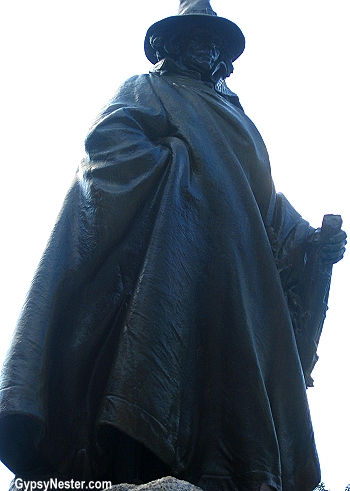
The word witch simply means "wise" and the term pagan, refers to the pagani, the hats worn by the country dwellers. Note the hats worn by pilgrims, and that statue above us. The term came to mean, the country folk. The Roman Church always took something of the locals and used it for their own then something else to demonize. Samhain, the high sabbat of my people, the Irish becomes All Hallows Eve…Halloween. Nov 1st becomes All SaintsDay. For my ancestors it was the beginning of the year, the time when the spirits of the beloved dead closest to the living. Communication was easiest.
April 30th the next high sabbat, beginning of Spring and a time of fertility. May Day is the Roman replacement. They took our benevolent antlered god and made him an evil horned Devil, which does not exist in the bible. They also stole one of our Goddesses and made her St. Briget.
Christmas, December 25th is the Roman Saturnalia. The christ story comes from Mithras and before that from India, Krishna. Jesus is my Rabbi (teacher), not my God.
What is all this about? Money and Power. Power and Money. It always is.
The real Holy Land seems to be India. There was a PBS show on that. Buddhism also starts there…hummmm.
Great post. I visited Salem in 1977 and as I recall, the cheesey witch related stuff wasn't as prevalent then. I loved the Salem Witch Museum for it's interpretation of the hanging times.
Most of the witch accusations in Europe were also about land and money. Too bad all of it has caused such a stigma about Wicca as a faith-based practice. It really is a gentle, nature based, non harming way of life.
Love your post, love your site. This is relevant. I'm going to post it on my Facebook page. Thanks for a thoughtful, interesting and immensely entertaining piece, as usual.