The Italian island of Sardinia (Sardegna) brought out the adventurer in us.
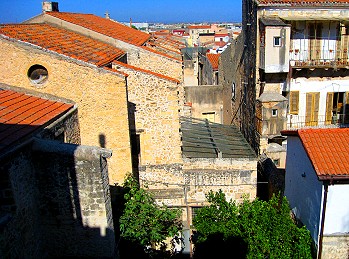
Our first stop was Sassari, a city of about 120,000 with a rich history dating back to the early Middle Ages.
Sassari is a college town, home to the University of Sassari that was established in May of 1562.
Our host, Gianluca, a treasure trove of Sardinian lore, put us up at the Hotel Vitorio Emanuele in the center of the old city.
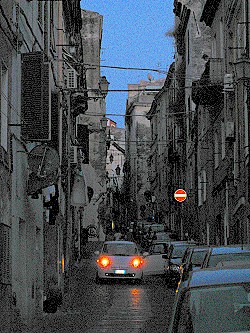
As we walked around the meticulously preserved town centre, we found cobblestone roads, ancient buildings and streets so narrow we could touch the walls on each side at the same time (yet locals navigate cars, trucks and scooters with side mirrors-tucked-in ease).
The dialect of the people around us, especially the children, sounded beautiful, like music.
Sassari can seem foreign to modern, New World eyes, yet we soon discovered that behind the ancient veneer were 21st century conveniences.
In our hotel, we found motion sensor lighting, video security, wireless access and a staff that spoke an amazing repertoire of languages, seamlessly moving from guest to guest.
Just a passing glance, or in Veronicas case an intentional snoop, into the open doors of the homes revealed all of the newest gadgets. State of the art kitchens with gleaming, compact appliances, LCD screens on flatscreen TVs and computers and furniture to die for.
Over the first nights dinner, conversation turned to local food and customs. Gianluca mentioned that horse and donkey were the “national foods” of Sardinia and that people who are not from the island can find them hard to eat.
It wasnt meant as a challenge, but to us, the gauntlet had been dropped. Since David had tried horse on a previous visit to Italy, it was obvious that we must eat the ass.
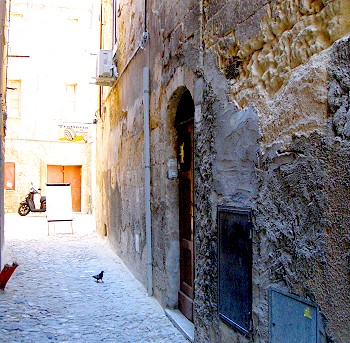
Sniffing around the next day, we found an intriguing little local haunt called Trattoria da Peppina in a tiny piazza near our hotel.
Turns out asinello (little donkey) was one of the least adventurous menu items. Spinal cord, small heads of lamb, three kinds of snails, various entrails, and goat feet were all available, as well as several things we couldnt decipher even with our fairly complete dictionary.
This was it – wed found our place. The nervous, obvious jokes preceded our meal – “Thats some nice ass,” “Theres just nothing like a good piece of ass,” “Howd you like to bite my .
Well, you get the idea.
We were hoping a nice sauce might cover our ass, but as we were enjoying our pasta “first plate” we heard the distinct sound of meat on the grill.
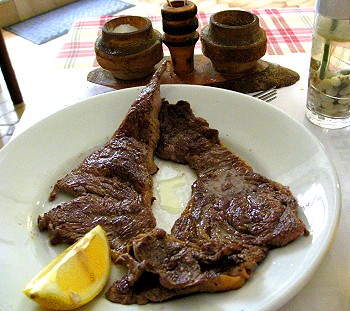
Sure enough, the ass was served straight up, all alone on a plate, grilled to perfection.
They even went so far, perhaps by accident, perhaps not, to serve it in a shape that could be seen as a toilet seat or a human butt. Lemon and salt were added as we summoned our courage.
The steak was cut, rather tentatively, and the first bite sniffed and inspected. Smelled good, looked OK . Here we go. Its good! No, really, its good.
Fully expecting to only try a bite or two, we ate every bit. Its really good.
So now, best of all, at dinner we could truthfully say, “No thank you, I had ass for lunch.”
Sassari sleeps in the afternoons, so it felt as though we had the whole place to ourselves, but we did find the Museo Nazionale Sanna open. The museum houses some of the earliest Stone Age and Neolithic finds on the island.
Phoenician and Carthaginian pottery and gold jewelry, Roman statuary, a sprinkling of coins, bronze belt buckles and a stash of heavy Roman boat anchors that pay homage to Sardinias seafaring history share the space with the art collection of Giovanni Sanna, whose family built the museum.
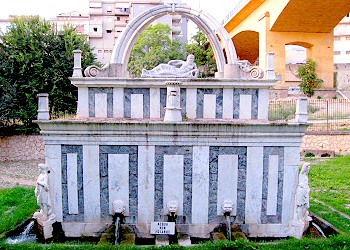
A trip to Sassari is incomplete without a visit to her famous fountain, Fontana di Rosello, crafted in 1606. The fountain first supplied the aqueduct for the nearby seaport of Porto Torres.
Later, the citizens of Sassari hauled the water away in buckets by hand and on donkey – we assume before dinner.
A souvenir shop hocking tee shirts that read “No Mirto, No Party” caught our attention as we strolled. Intrigued, we stepped in to ask the proprietor about Mirto.
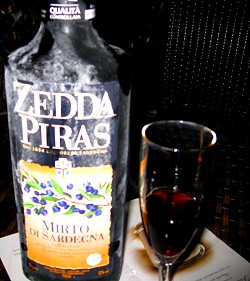 With little language in common, we learned through hand signals and interpretive dance that Mirto is a traditional Sardinian liqueur that tastes harmless, but in a half an hour all hell breaks loose.
Immediately upon arrival back at the hotel, we started our research. Mirto, we found, comes in two varieties, red and white, and is made from the myrtle plant – the red (rossa) is made from the berries, the white (bianca) from the leaves.
Nothing about hallucinations. Since we were not sure who to trust – Wikipedia or the guy at the souvenir shop (could he have been exaggerating just to sell us a tee shirt?) – we felt that further, more personal research must be done.
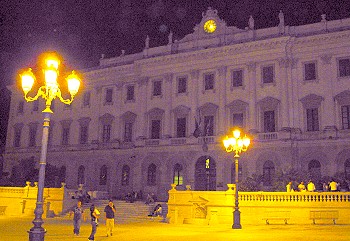
Our quest for mirto took us to Piazza Italia, home of the only clock in Sassari that told the correct time. It resides on the provincial capital building, the Provincia di Sassari. After dark, Sassari really comes alive.
The plaza was filled with outdoor cafes, strolling families, necking teenagers and, as always, the old guys sitting on benches, watching.
Situated at an outdoor table, we started with the Mirto Rossa. Very sweet, thirty-two percent alcohol, with a back taste of herbs.
We enjoyed some people watching, letting some time pass, hoping that the effects of the drink would not be too harsh. Still coherent, we shared a Mirto Bianca. The herbal taste of the Bianca is more obvious, as the sweetness of the berries has been eliminated.
Again we wait for the hallucinations. Nothing.
Our study concluded that while Mirto will warm your spirit, its probably best not to expect a mind-expanding experience, but it may make you want to exclaim the local howl of “Aiooo!”
David & Veronica,
GypsyNester.com
Like!! Really appreciate you sharing this blog post.Really thank you! Keep writing.
Great post. I’ve never been to Sardinia but lived in Italy in the early 70s (junior year of college) and my favorite line from this post is “…Piazza Italia, home of the only clock in Sassari that told the correct time.” Actually, it’s amazing that ANY clock had the correct time, because it’s probably a moot point. I’ve never known a culture so animated and yet laid back at the same time. I always enjoy your posts from Italy! Oh, and I’m with Veronica — grappa scares me more!
As it should!
I went to Sardinia in the late 80s and drank both red and white Mirto while there and took a bottle of the red back home with me.
I DID hallucinate on several occasions after drinking it.
David- seriously? Good to know! Actually, grappa scares me more! -Veronica
Sounds like a mighty fine piece of ass. I had horse in the Philippines and enjoyed it. Looking fwd to some prime ass in Sardinia.
Awesome travel story! Hope you guys get to Sicily – I lived there for two years when I was in the Navy, and when I get young buck out of the house I’m planning to go back!!
We would love to go to Sicily. Definitely on our list.
Funny post! I am sardinian, algerian and English. Most people do not know where Sardinia even is! I am going back for New Years!
Thanks, have a blast!