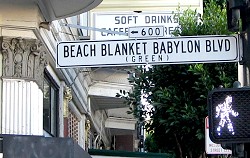
Growing up all we knew about San Francisco was that it was really cool.
Eric Burden sang about it, Otis Redding sat on its dock of the bay, and it required flowers in your hair if you were going there. Sure Tony Bennett left his heart there but Jimi Hendrix left his guitar, on fire!
Well… it’s true, it’s true, it really IS cool.
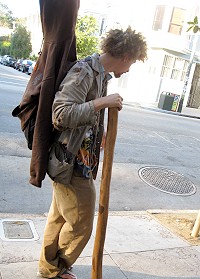
We rode the subway under the Bay into town (comforting ourselves with the knowledge that the odds of an earthquake rolling through while we were underground were minimal) and immediately encountered some modern day hippy wannabes trying to make the scene.
Haight – Ashbury may not be filled with real live hippies these days, it plays on that past as a tourist attraction rather than a current event, but it’s still far out.
The buildings, the views, the park make this district ooze with reminiscent coolness.
The shops with apartments over them along Haight. The houses stacked on top of one another along the sidestreets.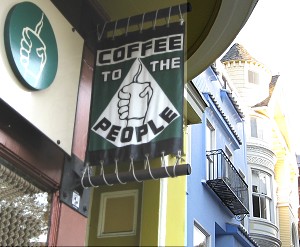
The groovy little panhandle connected to Golden Gate Park. It all adds up to make a very happenin’ little
neighborhood.
We quickly noticed San Francisco is a city of neighborhoods, each with a unique personality and style. A stroll of a few blocks — and bam!– a new and wondrous part of Frisco to discover.
The short — and shockingly steep — walk from Haight-Ashbury to The Castro gave us great views of the city from the hills of Buena Vista and Corona Heights.
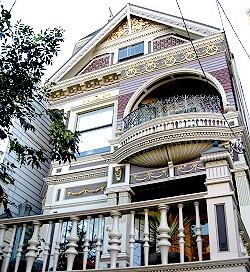 Made famous by the movie “Milk”, The Castro is considered the world’s largest gay neighborhood. Turns out, we may have the military to thank for this fact.
After WWII, when thousands of soldiers were dishonorably discharged as homosexuals, the military dumped them at the Pacific Theater Administration Center in San Francisco.
Many chose to stay in one of America’s most beautiful cities rather than face the discrimination likely awaiting in their hometowns.
These veterans settled in and transformed what was then called Eureka Valley but became known as The Castro, after the theater in the heart of the neighborhood.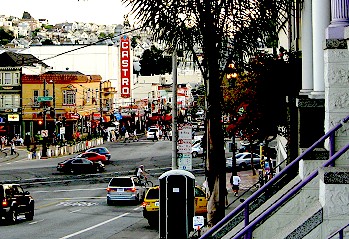
The two blocks of Castro Street south of the Castro Street Station are a sensory overload. We had to walk up one side and down the other to take it all in.
For a little break, we stopped in at The Twin Peaks Tavern for a beverage and as it turned out, some interesting conversation.
The group at the next table told us how Twin Peaks — “the gay Cheers” — was the first openly gay bar in San Francisco.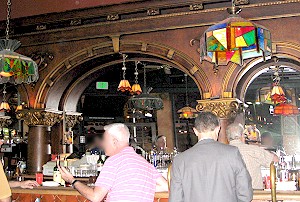
For years the fantastic picture windows overlooking the corner of Market and Castro were covered to avoid repercussions from the police and others, but by 1973 the times they were a-changin’.
The Summer of Love was long past, Harvey Milk had opened his camera shop and the Twin Peaks felt safe enough to open the windows for all the world to see.
Our knowledgeable new friends also filled us in about the famous Castro Theater. A popular San Francisco movie house since 1922, The Castro now hosts film festivals and revivals as well as tributes to some of Hollywood’s legends.
The old palace has maintained its glory through the years right down to the “Mighty Wurlitzer” pipe organ playing before shows. The marquee alone is worth the visit.
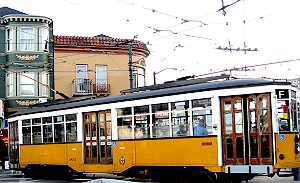
We bid our farewells and hopped on the F-line street car for a ride right through downtown and on to Fisherman’s Wharf.
The city has restored several of the old street car lines, not to be confused with the famous cable cars.
The street cars grab electricity from an overhead wire and can’t handle the steep hills like the little Rice-a-Roni fellas can with their underground cables.
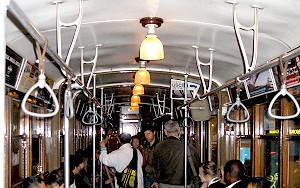
A fleet of classic streetcars from the late forties have been restored and put back into service along with eleven 1928 models acquired from Milan, Italy.
We were lucky enough to get one of the Italian gems to clatter and clank through town until we reached the old waterfront.
This area, though ridiculously touristy, has a distinct personality as well. It’s pretty much all about fish. Fish markets, seafood restaurants and cheesy fishy souvenirs.
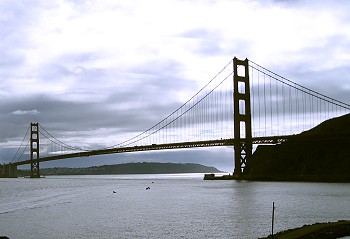
But underneath the tacky veneer there is a very cool neighborhood in the shadow of The Golden Gate Bridge and overlooking The Rock. Yup, perhaps San Francisco’s two most famous sights are both visible from here. The bridge spans the entrance to the harbor and Alcatraz sits right in the middle of the famous bay.
We coped a squat on the dock of the bay to check them out and to watch the seals and birds romp and dive in the harbor. They’re pretty into fish too. From one tourist Mecca to the next, it was time to see Chinatown.
 The easiest way to get from Fisherman’s Wharf to Chinatown is on the Powell-Mason cable car line over Nob Hill.
The little cars have been running up and down Nob Hill since 1873 by grabbing an underground cable and being pulled along.
The cable is gripped with a viselike mechanism that is operated by the gripman via the grip lever. It takes an expert hand to smoothly grab the moving cable without tossing passengers all about the car.
On the steep downhill the gripman becomes the brakeman. He must skillfully avoid a runaway car resulting in a disturbing mishap that involves destroyed historic transportation and flying fried rice and vermicelli.

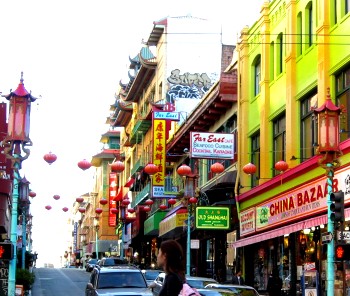
San Francisco’s Chinatown is the oldest in North America and one of the largest Chinese communities outside of Asia.
It is also a top tourist attraction, drawing more visitors every year than the Golden Gate Bridge.
This too is a unique neighborhood with incredible shops and restaurants as well as the day to day business of life in this vibrant community.
With all of the signs written in Chinese and the strange, exotic foods and wares on display in the windows, it’s hard to imagine any place else in America that feels as much like a foreign land as this.
On our way out of town the next day, we decided to drive over The Golden
Gate Bridge. This gave us a chance to check out Oakland and use our Oakland neighborhood guide. From there we swung around to the north so that we could cross the famous span heading south into the city.
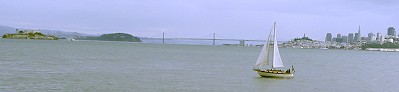
This also gave us the chance to stop at the Golden Gate National Recreation Area just above the northern approach to the bridge. A short hike up to Battery Yates from Horseshoe Cove yields fantastic views of the bridge, the bay and the city.
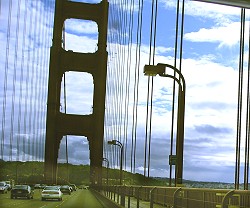 We crossed the channel as the sun broke in and out, lighting different portions of the city and bay as the wind blew the clouds along.
From our two hundred and fifty foot high perch atop the bridge we scanned the open Pacific on our right, the bay to our left and the hills of Frisco spread out ahead.
Driving across, we noticed signs and suicide hotline telephones all along the bridge.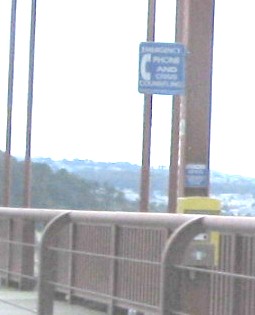
Turns out that The Golden Gate Bridge is the preferred spot to commit suicide in the United States and one of the most popular in the world.
There is no official count, since many jumps are not witnessed, but the total is in the thousands.
People travel to the Golden Gate specifically to jump, leaving abandoned rental cars, empty motel rooms and a mystery.
Not everyone succeeds, at least twenty-six hardy souls are known to have survived the fall, having hit the water feet first at just the right angle — then not freezing or getting eaten by a shark.
It’s unclear how many, if any, of these survivors were thrill seekers attempting a crazy-barrel-over-Niagara-Falls kind of endeavor.
So why not put up a fence to stop all of this free falling? Well,
a fence would disrupt the form and balance of the bridge just enough to possibly destroy it.
Wind could catch the barrier and begin to rock and roll the entire structure until it catastrophically fails. So no fence, but in 2008 the Golden Gate Bridge Board of Directors voted to install a net below the bridge as a suicide deterrent. So far a lack of funding has held up the process.
Our twisted little minds couldn’t help but ponder possibilities. Would jumpers bounce like a trampoline? Would others jump just to test the net?
What would they do with all of the people stuck in the net after they took the leap? Enough of this crazy contemplation!
Reaching The Presidio on the far side of the bridge, we shook the flowers out of our hair and headed down the highway. Unlike Mr. Bennett though, we only left another little piece of our hearts in San Francisco.
David & Veronica, GypsyNester.com
This post may contain sponsored links.
>nice tour through the hot spots guys! and yes, unfortunately the golden gate holds a special allure for many to end their lives. a great (albeit difficult to watch) documentary called "the bridge" was made about just that. hope you also made it over to our side of the bay! if not, next time 🙂
>nice! except leave those flowers in your hair until you get thru Marin County : > )
>Love that city on the bay! Was just there two weeks ago! You did a nice job of assembling the multitude of SFO's different parts into a sweet, easy to digest package. San Francisco has something for everyone…I love going there – with or without flowers in my hair.
>San Francisco is one of my very favorite places in all the world. As you noticed, it's quirky, bohemian, fascinating and visually stunning.
And it has the best supermarket in the cosmos. The Marina Safeway, just down from Fort Mason. I'm getting around to blogging about some of the glorious meals there, and I'm back for more in April.
For the full bridge experience, you should rent bikes from Fishermans Wharf. The ride – stopping at the Palace of Fine Arts along the way – gives you increasingly superb views of the bridge until suddenly you are on it, up close with the signs, the towers, the tourists peering over the railing at the huge ships passing underneath…
Whiz down the hill to Sausalito, lunch in one of the many restaurants, then load your bike with all the others onto the ferry and glide back past Alcatraz.
I did this in October and it was the BEST day of my life. Fair dinkum.
Skyring — wow! Great tip — sounds like heaven. Next trip…we’re on our bikes! Have to say some of the hills look quite daunting, but, duh, we didn’t have to do the WHOLE trip on foot!
Thanks so much for sharing!
>I left my own empty nest in 2004 at the age of 52 and moved to SF to find my missing youth! Lived there for three years and loved the vibe. Now I'm chillin' in Reno. If you're headed up this way, I'd love to meet you. I've been following your adventures for a while. I follow you on Twitter and FB, too.
Awwww…Iris! You are a doll! We are not going to make Reno this trip, but thanks so much for the invite! We would LOVE to send you a GypsyNester jersey tee (if you promise to wear it proudly!) Shoot us an e-mail at [email protected] with your address and size (mens m, l or xl)