

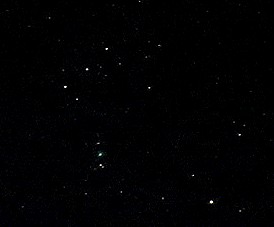
Looking up at the night sky at an out-in-the-boondocks National Park sent my thoughts wandering, as only the night sky can. Then came a shocking thought:
How long until we can no longer see the stars?
Sitting up and scanning the land around me I saw the bright dots from tiny little towns – and, alas, the Park itself – enough light pollution to hinder me from observing what The Ancients or Magellan or Shakespeare would have seen in their day.
Growing up in the desert of California, the stars danced over my head. As a Girl Scout I consulted a guidebook, sought out the major constellations and relished the romantic stories behind them.
But if there are kids currently living in my childhood home, they most likely never see those big beautiful balls of gas. The area has grown much too populated.
Don’t get me wrong – I enjoy being able to see where I’m going at night without tripping and breaking my face. Humanity’s scientific progress has given me much – the ability to read comfortably in bed or not getting attacked in a dark alley being among my favorites.
As long as I’m being honest, I’ll admit that outer space scares the crap out of me. I find it rather daunting to think that I’m but a speck-on-a-speck dancing around an outrageously huge universe. I don’t cotton to being insignificant – it messes with my self-centered human sensibilities.
Because of this, I understand why the Ancients wrote stories about the constellations, why the stars were tied in with so many belief systems. People like me have to bring the stars down-to-earth somehow or the entire thing just gets too much for us. If I didn’t have anything to do at night but look at the stars, I’d be making up stories about them too – just to make sense of the whole thing.
I forced my attention back to our Park Ranger as she pointed out the Pleiades. Seven beautiful, virginal sisters sent off into the sky for the safekeeping of their virtue while poor pent-up Orion chases after them for eternity…
Again I sat up with a ghastly thought.
My future grandkids (if it’s in the stars) might never see this.
I began to wonder why this was so distressing to an outer space fearer like myself. A major reason would be our connection to our past.
How can we possibly teach about ancient societies to a kid who has never really seen the stars?
How difficult will it be to explain to a city-dwelling child with every up-to-the-minute light emitting electronic gadget that the sky provided our ancestors entertainment before the onset of reality TV, Nintendo and the Metroplex Cineplex Imax 36?
As for the Explorers – those incredibly brave, ballsy men who discovered new worlds and trade routes – the stars must have been wondrous indeed. I imagine that even today, if a person is hanging out in the middle of the Atlantic Ocean, those celestial orbs are plenty bright to guide the way to his destination.
No longer needed for navigation, I wonder if a ship’s crew look away from the GPS systems long enough to enjoy the beauty of the night sky. Do passengers leave the gaming tables, endless buffets and showrooms to visit Orion and his taunting little virginal vixens?
What if Shakespeare hadn’t seen the stars? What would we have lost? Would Romeo and Juliet be those achingly beautiful star-crossed lovers without the night sky? We might have ended up with blood pudding-crossed lovers or, worse, just an ordinary pair of very upset teenagers.
My hope for our future grandkids is they understand society, history, romance and literature in a meaningful way. Then and there I vowed that I would be the one to show them the stars.
I spent the next few hours gazing on the heavens, dreaming up ways to trick the little buggers into leaving their state-of-the-art smart phones at home, if only for one night.
Veronica, GypsyNester.com

One of the highlights of my parenting career was when my then 10 year old son got up at 3:00 a.m. with me to drive to and lay out in a chilly field to see the Leonid meteor shower one night. There are still places on this earth where one can see the Milky Way, my unscientific gauge of the amount of ambient light—sometimes natural from the moon. Our best stargazing ever was on our honeymoon (in 1982) from a small 5 person boat in the Amazon. We were taken a few miles up river from where we were staying in the jungle and at sunset, we cut the motor and drifted back with the river current. It was the southern hemisphere heavens–so clear, we could see satellites moving across the sky. Couple that with the night jungle sounds which crescendoed as the darkness fell and that night qualifies as an “I’ll always remember” time.
It’s true that light “pollution” extends further and further outside our cities, but whenever I fly over the high plains and look down on “nothing” for miles and miles, I think it will be awhile before the night sky truly disappears. By then, maybe the high plains will be on the coast 😉
Wow, the night on the Amazon sounds amazing. What a great memory! Thanks for sharing it.
Texas has some of the best night sky you can see anywhere. Check out the area around Big Bend national park in the Davis Mountains and the Padre Island National Seashore. Fantastic.
You are so right! We went to McDonald Observatory in the Davis mountains after we wrote this. Here’s a story about it. https://www.gypsynester.com/mf.htm
Not being able to see the vast array of stars in the black sky prevents us from being reminded every night just how small and insignificant we really are. Humanity needs to remember that. 😉
Excellent point, Rita!
My DH and I have promised each other that we will never live somewhere we can’t see the stars. We are concerned that our kids DO. I love your promise to share the stars with your grandkids! We have eight. I have already started waking u…p available youngsters for the thrill of celestial events … Sharing the lunar eclipse with my 10 yo grandson is a treasured memory for both of us. I would add, though, that I use google sky maps on my smart phone to merge their love of electronics to the real world of nature. Geocaching with my grandkids allows for the same techy outdoor fun!
Carol – Brilliant tip!
Tucson, Arizona has a light ordinance to protect the night sky as well as make it easier on the observatories that are located in the area.
I have always said that if I win the lottery I am going to start a foundation that educates and gives away light sheilds that keep street lights and even house lights pointed DOWNWARD but not up into the sky. Light pollution is one of my least favorite forms of pollution.
There’s a passionate grassroots movements to preserve the night skies — http://www.stateline.org/live/ViewPage.action?siteNodeId=136&languageId=1&contentId=15563
Kavan- Very thoughtful and informative piece. Thanks for sharing!
I think this is why I love to live on the edge of town. While living in town would be awesome, I love coming home to a starry sky at night.
Is it true, do you think , that you can’t miss what you’ve never had? How provative and sad is that?
excellent post, I really miss the stars living in the city. I grew up in the suburbs where there were a good number of stars and have spent time in remote places where the skies are just full of stars, such an inspiring sight….